
01 — Height Zones
Five Ceiling Height Zones — Different Rules for Each
Each height range changes fan diameter, RPM setting, installation method, and which product is correct. There is no universal answer.
<3.5m
TOO LOW
HVLS cannot be safely installed
Minimum safe clearance between blade tip and floor cannot be achieved. Traditional ceiling fans, pedestal fans, or wall-mount fans are the correct solution at this height.
Traditional fans
3.5–6m
LOW RANGE
Small HVLS — short column, constrained spread
Air column has limited vertical travel. Coverage per fan is reduced. Smaller diameter fans (Ø 3.1–4.3m) required to maintain safe clearance. Multiple units may be needed.
Ø 3.1–4.3m · 350–600m² per fan
6–12m
★
OPTIMAL
★ Peak HVLS performance — maximum coverage per fan
The sweet spot. Air column develops fully, spreads to 40–50m floor diameter. One 7.3m fan covers 2,000–2,500m². Full destratification benefit. Best energy efficiency per m² covered.
Ø 5.5–7.3m · Up to 2,500m² per fan
12–18m
HIGH BAY
Max-diameter fans + drop rod adjustment required
Column velocity begins losing momentum over the longer drop. Compensate with maximum blade diameter (7.3m), drop rod to bring fan closer to occupied zone, and slightly higher RPM setting.
7.3m max · IP65 · Drop rod required
>18m
VERY HIGH
Multiple fans + staggered heights — specialist layout
Cathedrals, hangars, mega warehouses. Single fan cannot bridge the full height. Solution: fan at mid-height on extended drop rod, or multiple fans at different levels. Requires site-specific CFD analysis.
8-blade · Max airflow · Site survey required
02 — How It Looks Inside
Three Heights — Three Different Airflow Stories
Same fan diameter. Different ceiling height. Completely different floor coverage, velocity, and comfort outcome.
❌ 4m Ceiling
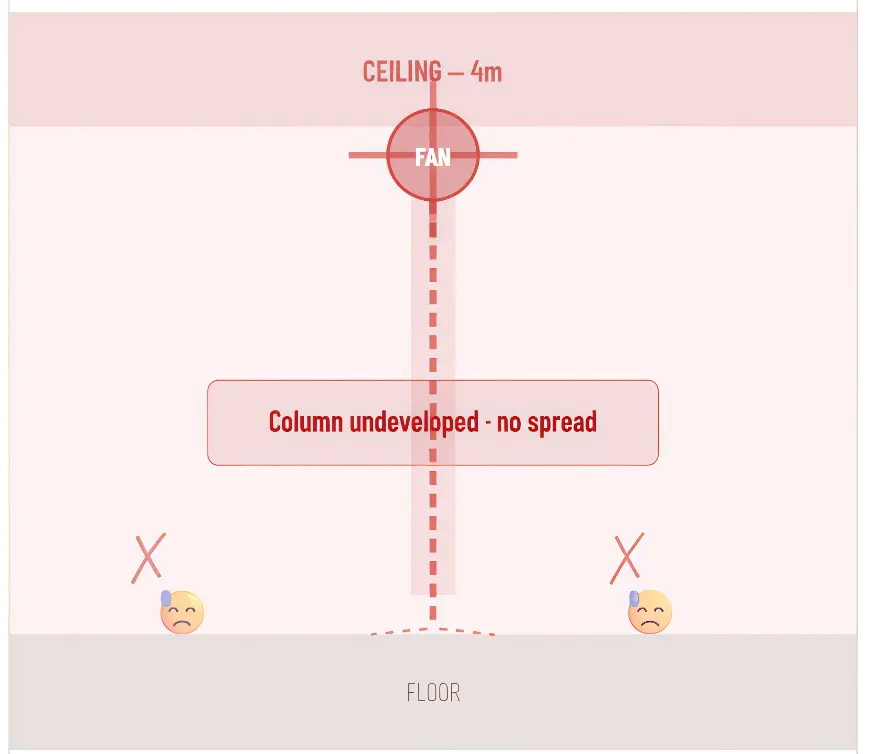
Floor spread
~6m only
Coverage / fan
~30m²
Floor velocity
Inconsistent
★ Optimal — 8m
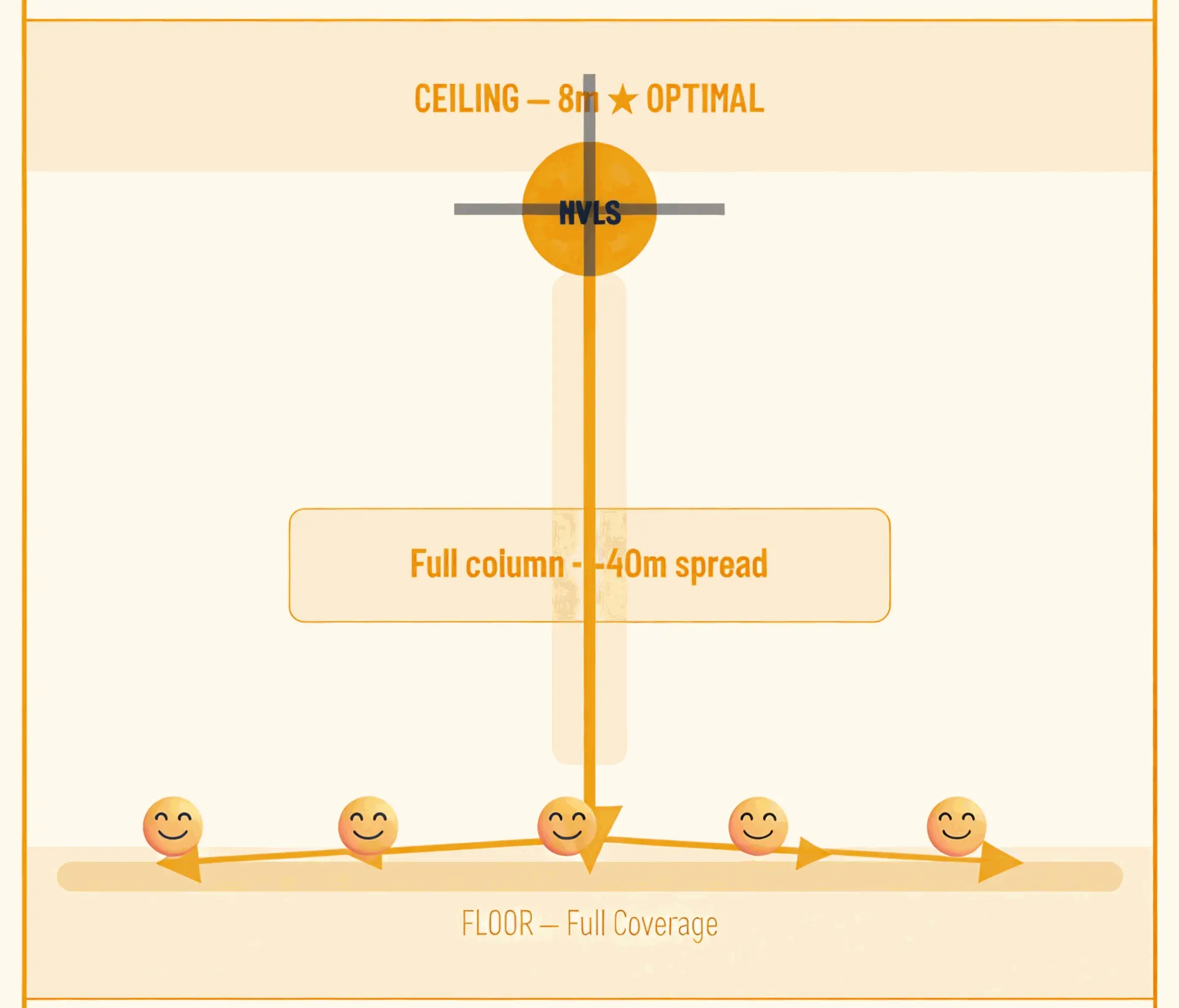
Floor spread
~40–50m
Coverage / fan
Up to 2,500m²
Floor velocity
0.5–1.0 m/s uniform
⚠ High Bay — 16m
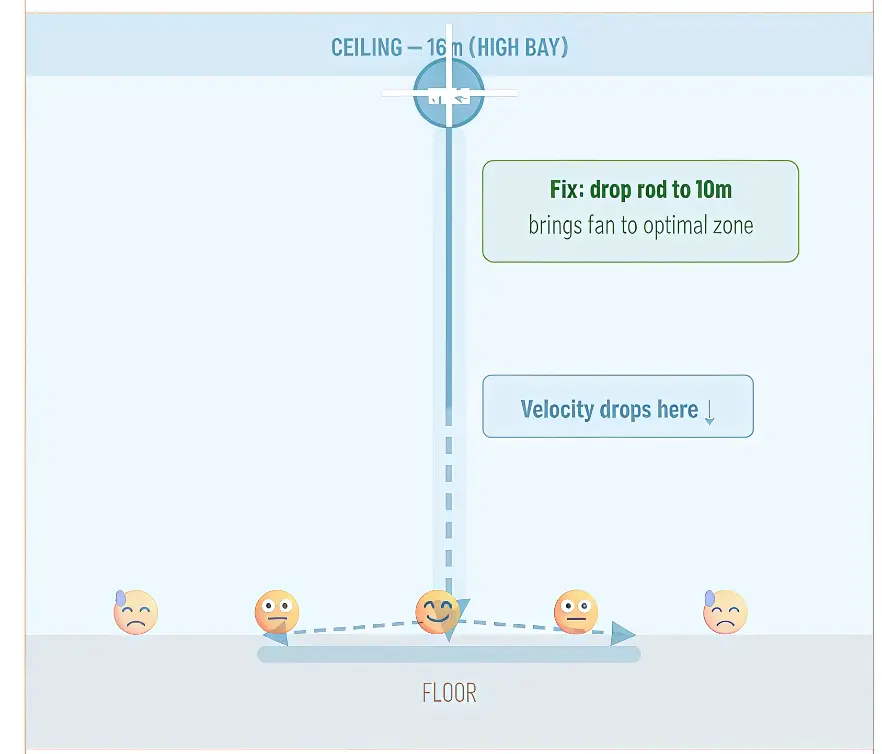
Floor spread
~20–25m
Fix: drop rod to 10m
→ 40m spread
Product
HERO-6 V380e
03 — The Physics
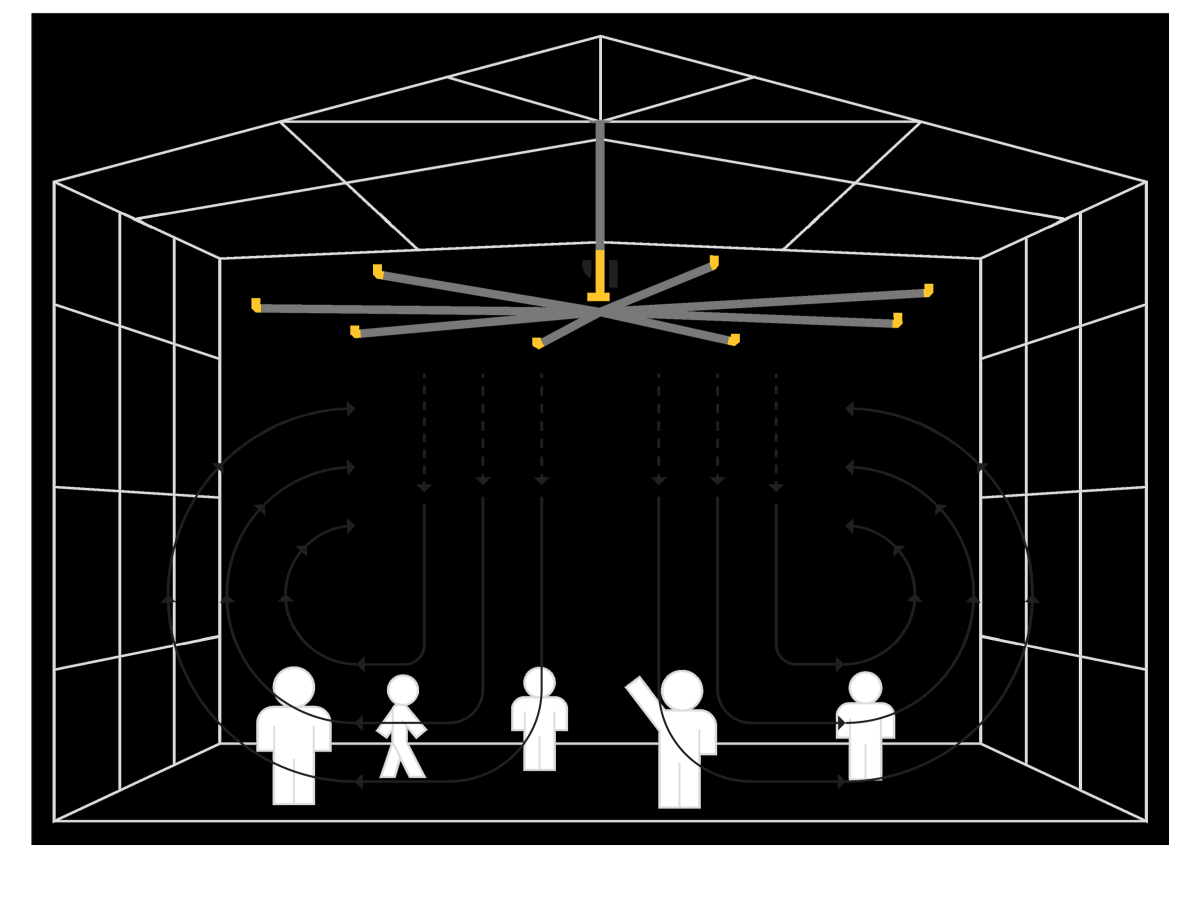
How Height Determines Floor Spread
The relationship between ceiling height and floor coverage is predictable — and measurable. Here's how it works.
H
Ceiling Height
×
D²
Blade Area
×
RPM
Rotation Speed
=
Spread
Floor Diameter
04 — What Goes Wrong
Three Mistakes That Kill Airflow Performance
Most underperforming HVLS installations share one of these three root causes — all related to ceiling height being ignored at specification stage.
Mistake 01
Wrong fan size for ceiling height
Using a 7.3m fan in a 4m ceiling space — or a 3m fan in a 10m ceiling. The air column either never develops (too low) or dissipates before reaching the floor (too small for height). Both deliver poor floor coverage.
→ Fix: match blade diameter to ceiling height zone per specification table
Mistake 02
Fan mounted at actual ceiling — no drop rod in high bay
In a 16m warehouse, mounting the fan flush to the roof means the air column loses velocity over the 16m drop. Floor airspeed falls below 0.3 m/s — below the evaporative cooling threshold. Workers feel nothing.
→ Fix: extend drop rod to bring fan to 8–10m effective height
Mistake 03
Too few fans, relying on "extra spread"
Underspecifying fan count based on theoretical maximum coverage. When actual ceiling height or obstructions reduce spread, significant dead zones appear. Workers report inconsistent comfort across the floor.
→ Fix: use 15–20% overlap in coverage planning; verify with site survey
Hamilton Air HVLS Range
Industrial Ceiling Fans HERO Series
The Hamilton Air HVLS range — PMSM gearless motors, aerodynamic aluminium blades, IP55 to IP68 protection. Coverage from 600 m² to 2,000 m² per fan.
HERO-5 V300i
Standard workhorse — ideal for light manufacturing facilities, showrooms, supermarkets and sports halls. PMSM gearless motor, VFD control, minimum ceiling height 3.5m.
View Details →HERO-5 V200i
Compact variant — optimised for mid-size warehouses, workshops and schools. Minimum ceiling height 3.0m, lightweight construction, straightforward installation.
View Details →HERO-6 V380e
Next-generation model — 3-phase 380V PMSM motor, IP65 dust-tight and water-jet protected. Optional IoT connectivity, app control. Designed for logistics warehouses and manufacturing plants.
View Details →HERO-6 ADF
Advanced Distributed Flow (ADF) technology delivers uniform airflow across the entire footprint, eliminating hot spots. Optimised for shopping centres and mixed-use industrial spaces.
View Details →HERO-6 X Series
IP65 / IP68 rated — unique in the Vietnam market. Operates under direct wash-down conditions: food processing plants, aquaculture facilities, seafood processing and coastal environments.
View Details →HERO-8 ADF
Flagship — 8-blade ADF up to 7.3m diameter. Maximum airflow for mega logistics warehouses, airports, exhibition centres and large-scale sports venues.
View Details →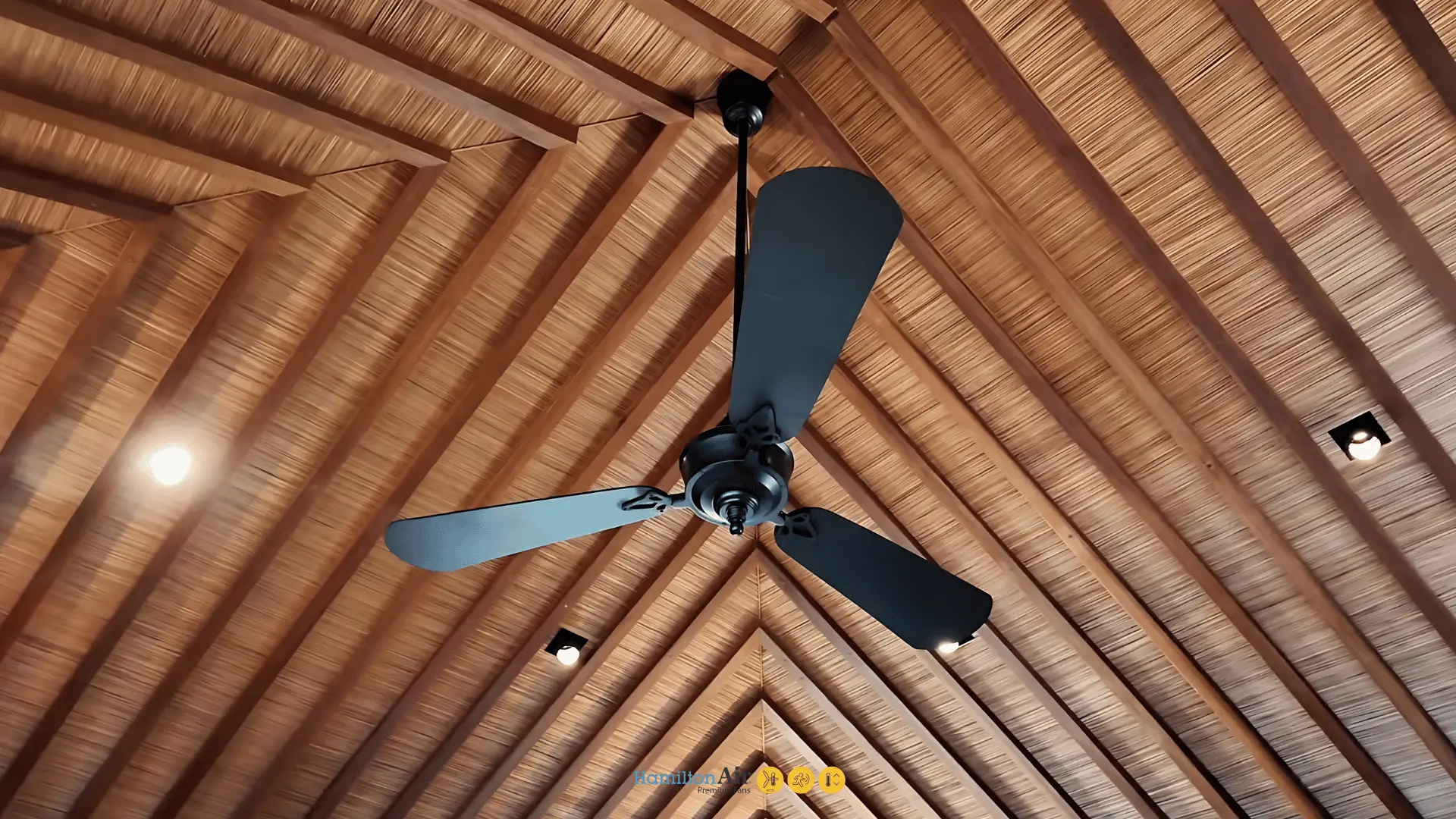
Question
Quick Answers
3.5m is the absolute minimum for the smallest V200i fans. This provides the mandatory safe clearance between blade tip and the floor. For the V300i 7.3m diameter fans, minimum installation height is 5m. Below these thresholds, HVLS cannot be safely installed. Traditional ceiling fans (like Pandora V150e/V180e) or pedestal fans are the correct solution for spaces under 3.5m.
The air column needs vertical distance to develop momentum and spread at the floor level. At 4m, the column hits the floor before it can spread — like pouring water from 10cm height versus 1m height. More height means more horizontal spread. Between 6–12m, the column develops fully, reaching a 40–50m floor diameter. This is why a single 7.3m fan can cover 2,500m² at optimal height, but only 80–100m² in the same space with 4m ceilings.
A drop rod (also called an extension rod) is a rigid vertical extension that lowers the fan from its ceiling mounting point to a more effective operating height. Required for ceilings above 12m — in a 16m warehouse, installing the fan on a 6m drop rod brings the effective operating height to 10m, which is within the optimal 6–12m zone. Without a drop rod, the air column loses velocity over the long descent and delivers insufficient floor airspeed.
One 7.3m HERO-5 V300i at 8–10m ceiling can cover up to 2,500m² — roughly a 50m × 50m square. For a narrow but long warehouse (20m × 120m), you would typically need 3 fans spaced 40m apart along the length, with 15–20% coverage overlap to eliminate dead zones between fans. The layout should be designed based on the actual floor plan, not just total area. Hamilton Air's site survey includes a full coverage layout model before any commitment.
Bắt đầu viết ở đây...