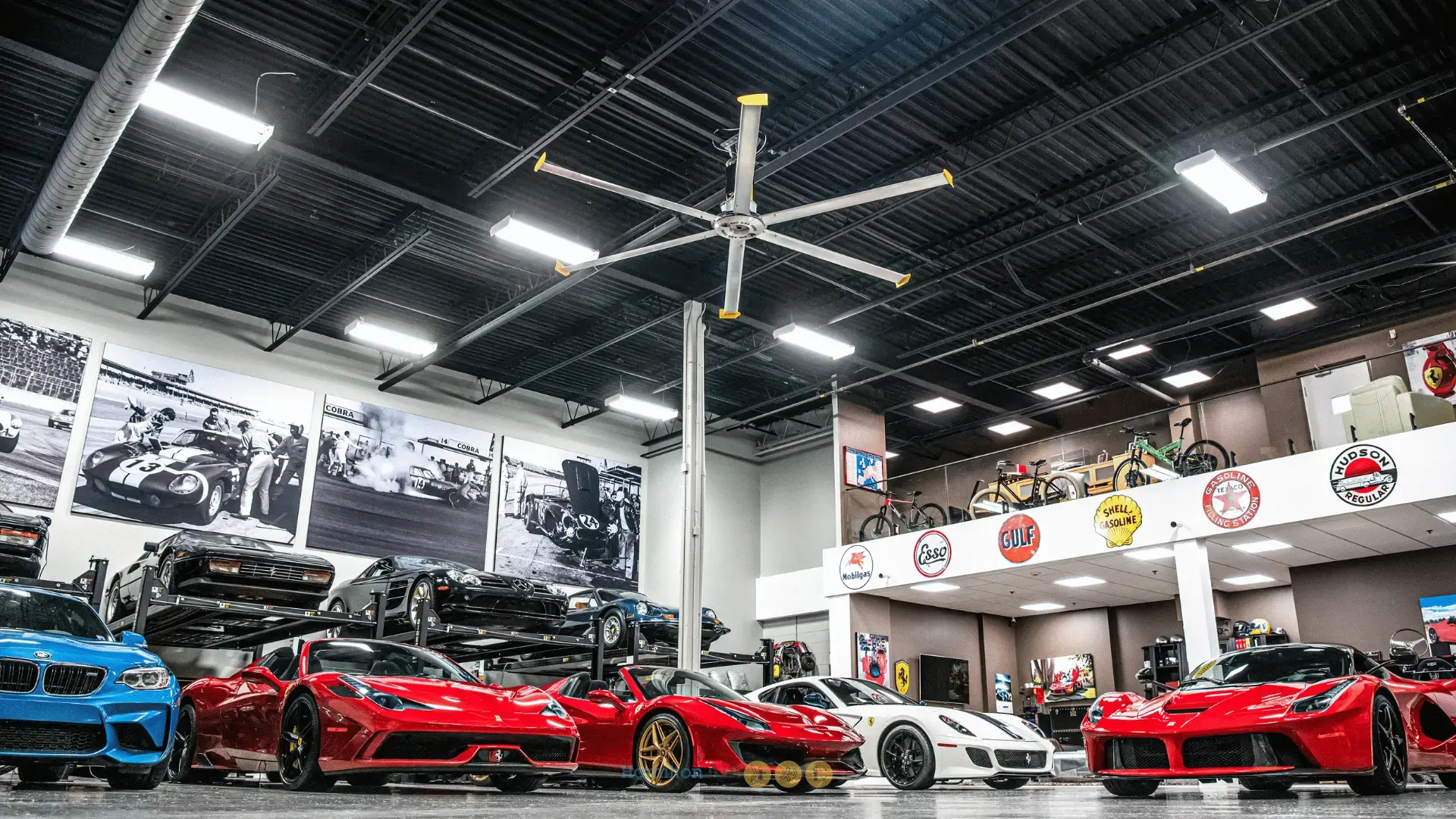
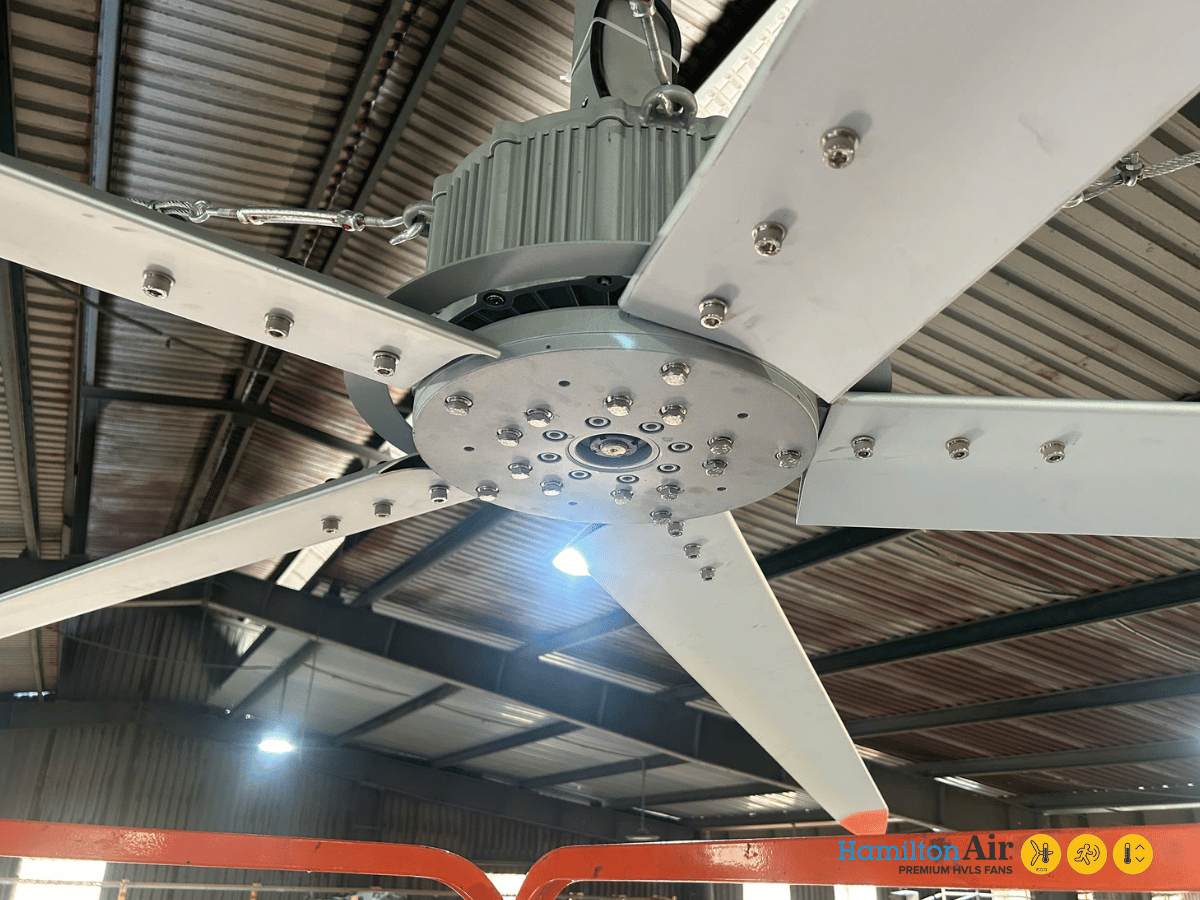
Quick preview — 2,000m² facility
Coverage (2,000m²) | 1 HVLS fan | 18–22 fans
|
Energy draw | 3 kW | 36–44 kW
|
Noise level | 45–55 dB | 75–95 dB
|
Floor coverage | Uniform | Spotty
|
Annual energy cost | ~$900 | ~$11,000
|
Annual maintenance | ~$0 | $2,000–$4,000
|
Motor lifespan | 50,000+ hrs | 3,000–8,000 hrs
|
01 — Before You Compare
They're Not Competing on the Same Playing Field
Understanding the comparison starts with understanding that HVLS fans and traditional industrial fans use completely different airflow strategies. They're not two versions of the same solution — they're fundamentally different approaches to the same problem.
HVLS Fan Strategy
Large blade. Slow spin.
Massive gentle volume.
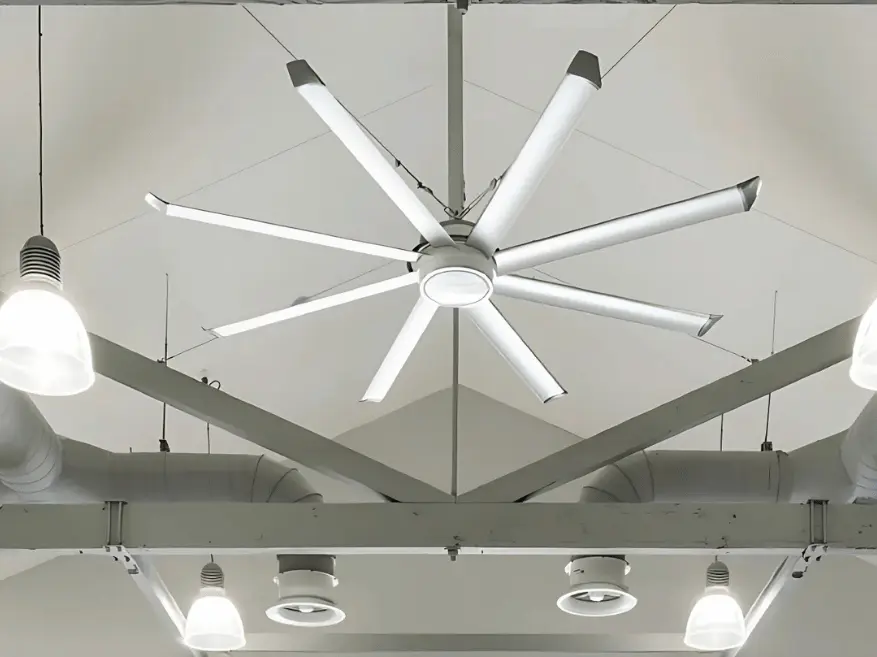
Rotates a large blade (3–7.3m) at low RPM to move a massive column of air gently downward, spreading uniformly across the full floor area. Low airspeed everywhere — but everywhere. Scales perfectly across large spaces with no dead zones.
Traditional Industrial Fan Strategy
Small blade. Fast spin.
High-velocity stream.
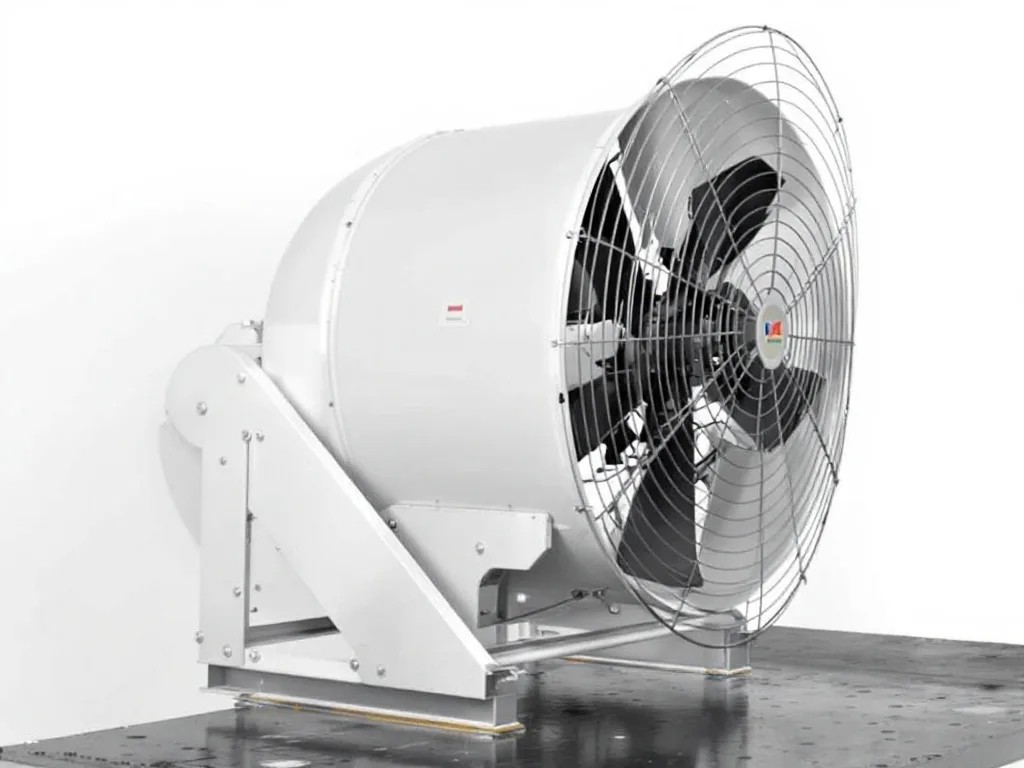
Spins a small blade at high RPM to generate a narrow column of fast-moving air aimed at a specific target zone. High airspeed locally, dead zones everywhere else. Works well for one person at a fixed station; scales poorly across large spaces.
02 — Head to Head
11 Criteria. Honest Verdicts. No Spin.
Each criterion is evaluated for a 2,000m² warehouse with 8m ceiling — the most common real-world comparison scenario. Click any card to expand the full breakdown.
01 Energy Consumption - HVLS Wins
HVLS wins by the widest margin of any category. The energy ratio is 12–15:1 in HVLS's favor for equivalent floor coverage. This single factor alone typically justifies the HVLS investment within 12–18 months — before any other benefit is counted.
02 Coverage Uniformity - HVLS Wins
HVLS achieves floor-level comfort uniformity that is physically impossible to replicate with traditional fans at equivalent fan count. The only way traditional fans match HVLS uniformity is to increase unit count by 3–5× — at which point energy costs become completely unsustainable.
03 Operating Noise Level - HVLS Wins
A 30–40 dB difference is not a small margin — it is the difference between a conversation and a shouting match. For facilities where communication quality matters (quality control, customer-facing areas, supervisory functions), HVLS fan noise levels are not just better — they're in a different category.
04 Upfront Purchase & Installation Cost - Traditional Wins
Traditional fans win on upfront cost for single-unit purchases. For full 2,000m² coverage, the comparison is closer than it appears ($3,000–$9,000 for 18–22 traditional fans vs. $8,000–$14,000 for one HVLS). HVLS capital is recovered through energy savings within 12–18 months — after which the traditional array continues costing $11,000+/year while HVLS costs $900/year.
05 Maintenance Requirements - HVLS Wins
Over a 10-year period, a 2,000m² traditional fan array accumulates $20,000–$40,000 in maintenance costs that simply don't exist for HVLS. Maintenance burden also has an indirect cost: production interruptions, facilities staff time, and the supply chain complexity of managing consumable motor stock.
06 Flexibility & Portability - Traditional Wins
Traditional fans win on portability — and this is a real advantage for temporary, outdoor, or frequently reconfigured spaces. For permanent facilities with stable layouts (the majority of factories and warehouses), this advantage rarely applies in practice.
07 Thermal Destratification (High Bays) - HVLS Wins
This is HVLS's most unique advantage — there is no traditional fan solution for thermal stratification. In high-bay facilities, this benefit alone often justifies the switch, because it directly reduces AC load by 20–35% on top of the fan energy savings.
08 Targeted / Directional Airflow - Traditional Wins
Traditional fans win for spot-specific, highly targeted cooling at individual workstations. In most facilities, the right answer is HVLS for the overall space plus one or two traditional fans at specific workstations where spot-cooling is needed. Not either/or — both.
09 ESG & Energy Documentation - HVLS Wins
For facilities serving European or US export markets, the ESG documentation advantage of HVLS is rapidly becoming a commercial differentiator — not just an environmental benefit. Documented energy reduction is a supplier qualification requirement that traditional fans cannot satisfy.
10 Installation Speed & Complexity - Traditional Wins
Traditional fans win on installation speed for urgent or temporary needs. For planned permanent installations, the 1–2 day HVLS timeline is not a meaningful barrier — and the certification process provides structural safety assurance that unplanned pedestal fan arrays cannot offer.
11 Worker Productivity Impact - HVLS Wins
For operations managers focused on throughput and output metrics, HVLS's productivity impact is often larger than the energy saving in absolute dollar terms. A 15% pick rate improvement across 50 workers during 3 summer months represents significant revenue recovery — dwarfing the installation cost in many cases.
03 — The Long View
The 10-Year Cost Reality: Same 2,000m² Facility, Two Different Paths
Upfront cost is one data point. What you actually pay over the life of the system is the number that matters for capital expenditure decisions.
Hamilton Air HERO-5 V300i · 1 unit · 10 Years
Path A: One HVLS Fan
Installation (Year 0) | –$11,000
|
Energy cost (Years 1–10) | –$9,000
|
Maintenance (Years 1–10) | ~$0
|
Productivity gain (summer months) | +$45,000 est.
|
10-Year Net Position | +$25,000
|
20 Traditional Industrial Fans · 10 Years
Path B: Traditional Fan Array
Purchase + positioning (Year 0) | –$6,000
|
Energy cost (Years 1–10) | –$110,000
|
Maintenance + motor replacements | –$30,000
|
Productivity loss vs. HVLS (est.) | –$45,000
|
10-Year Net Position
| –$191,000
|
04 — Decision Framework
When to Choose HVLS — and When to Stick with Traditional
The honest answer: most large industrial facilities should use HVLS as the primary system. A minority of situations still favor traditional fans. Here's how to tell which is which.
HVLS Is the Clear Choice
Choose HVLS When Your Facility Has Any of These
Floor area above 500m² with ceiling height 5m or more |
Ceiling height 8m+ with significant thermal stratification |
Loading docks that open frequently — AC doesn't maintain setpoint |
Workers mobile across the floor rather than fixed at one station |
Operations where noise levels affect communication or safety |
Export buyers asking for documented energy reduction data |
Electricity bill makes up a significant share of operating costs |
Any facility running 2+ shifts where cooling costs compound daily |
Traditional Fans Are Still the Right Choice
Stick with Traditional Fans When
Space is under 300m² with ceiling below 4m — HVLS ROI is marginal |
Deployment is temporary — event, construction phase, rental facility |
One specific worker at a fixed station needs personal high-velocity cooling |
Facility layout changes frequently — fixed ceiling mounting is impractical |
Immediate same-day deployment is required with no installation lead time |
Outdoor or uncovered applications where ceiling mounting is impossible |
Budget has zero capital allowance — only operating expense permitted |
The Questions People Ask Most About This Comparison
For spaces above 500m² with ceiling heights of 6m or more, HVLS fans win across 8 of 11 comparison criteria — including energy, coverage, noise, maintenance, destratification, productivity, and ESG documentation. Traditional fans still win in 3 categories: upfront cost per unit, portability, and highly directional spot-cooling. For large permanent facilities, HVLS is the better system. For temporary, portable, or single-person spot-cooling needs, traditional fans remain the practical choice.
The fundamental difference is the airflow strategy. Traditional fans spin small blades very fast to generate a narrow, high-velocity air stream aimed at a specific target. HVLS fans spin large blades (3–7.3m diameter) very slowly to move a massive volume of air gently and uniformly across the entire floor area. HVLS creates whole-facility comfort with one unit; traditional fans create localized spots with dead zones between. To cover 2,000m², you need 1 HVLS fan or 18–22 traditional fans.
Yes — dramatically, on a per-m² covered basis. One Hamilton Air HERO-5 V300i (7.3m) covers 2,000–2,500m² at 3 kW. Covering the same area with traditional 0.9m pedestal fans requires 18–22 units consuming 36–44 kW — a 12–15× energy difference for identical floor coverage. Annual energy cost: $900 (HVLS) vs. $11,000–$13,000 (traditional array). The energy savings alone typically pay back the HVLS installation within 12–18 months.
In most large warehouse and factory applications, yes — with limited exceptions. Traditional fans still make sense for: (1) Very targeted spot-cooling at a fixed single workstation needing high-velocity personal airflow; (2) Temporary or portable cooling needs where ceiling mounting is not feasible; (3) Areas adjacent to open doors where a directional fan compensates for disrupted HVLS floor coverage. In most facilities, 90%+ of industrial fans can be replaced by an appropriately sized HVLS system. A small number of directional fans at specific workstations can complement the HVLS system for residual spot-cooling needs.
A quality traditional industrial fan costs $150–$400. A Hamilton Air HERO-5 V300i (7.3m) costs $8,000–$14,000 installed. However, the fair comparison for a 2,000m² facility is one HVLS unit ($8,000–$14,000) versus 18–22 traditional fans ($3,000–$8,800). The upfront difference narrows significantly. Over a 10-year operating period, the HVLS system generates $80,000–$130,000 in energy savings versus the equivalent traditional fan array — making the total cost of ownership approximately $150,000–$200,000 lower for HVLS.