
Each Benefit Resolves a Specific Problem. Find Yours.
These aren't marketing claims. Each benefit below includes the problem it solves, the cost of that problem, and the documented outcome after installation.
"Our cooling energy bill keeps growing — and we haven't changed our output."
— Every facility manager who looked at last year's electricity bill and compared it to the year before
Industrial AC systems sized for large spaces don't just use a lot of energy — they use it at a terrible efficiency ratio. A rooftop packaged unit running to cool 2,000m² draws 80–120 kW continuously. When loading dock doors open, when workers generate body heat, when machinery radiates heat — the AC compressor spins harder, burning more power to recover a setpoint it can never fully achieve in a leaky envelope.
The HVLS alternative runs on physics that AC cannot match at scale. One Hamilton Air HERO-5 V300i (7.3m diameter) covers the same 2,000m² consuming 3 kW. It doesn't cool the air — it moves it across the skin of every worker in the space, accelerating evaporative cooling at a fraction of the energy. The 27:1 energy ratio is not a marketing claim; it's a watt meter reading.
Annual operating cost at Vietnamese industrial electricity tariffs: $900/year for HVLS versus $24,000–$36,000/year for equivalent AC. The installation pays back in 12–18 months. After payback, the $23,000+ annual saving continues for 15+ years — every year, permanent, compounding as electricity tariffs continue rising.
Energy Data — 2,000m² Facility
HVLS operating draw | 3.0 kW
|
AC equivalent draw | 80–120 kW
|
Energy ratio | 27:1 HVLS advantage
|
Annual HVLS energy cost | ~$900/yr
|
Annual AC energy + maintenance | $32,000–$44,000/yr
|
Annual saving | $31,000–$43,000
|
Payback period | 12–18 months
|
10-year net saving | $220,000+
|
"Our AC is set to 26°C. The thermostat says 26°C. But workers say the floor feels like 34°C. Nobody can explain it."
— A problem unique to high-bay spaces that AC can never solve, no matter how powerful the system
Nobody is wrong. The thermostat reads the return air temperature at duct height — typically 3–4 meters above the floor. Hot air is less dense and rises. In a 10m ceiling facility, the temperature difference between the working zone and the ceiling can reach 20°C on a Vietnamese summer day. Your AC is cooling the air above where your workers actually operate.
This is thermal stratification — and it is a structural feature of every high-bay space. AC systems cannot solve it. You can run the compressor harder, lower the setpoint further, pay more electricity — and the physics of stratification will persist because AC cools air at the duct outlet height, not at floor level where workers breathe.
HVLS fans resolve stratification as their primary physical mechanism. A 7.3m fan creates a large-diameter column of air from ceiling to floor, continuously mixing the warm ceiling layer down through the cooler floor-level air. The result is a 4–6°C floor temperature reduction with no refrigeration whatsoever — purely from redistributing the thermal energy that was already present in the space.
In AC-equipped facilities that add HVLS fans, destratification typically allows the AC setpoint to rise 3–5°C while maintaining the same floor comfort — reducing compressor run-time by 20–35% and delivering a significant energy saving on top of the HVLS energy saving itself.
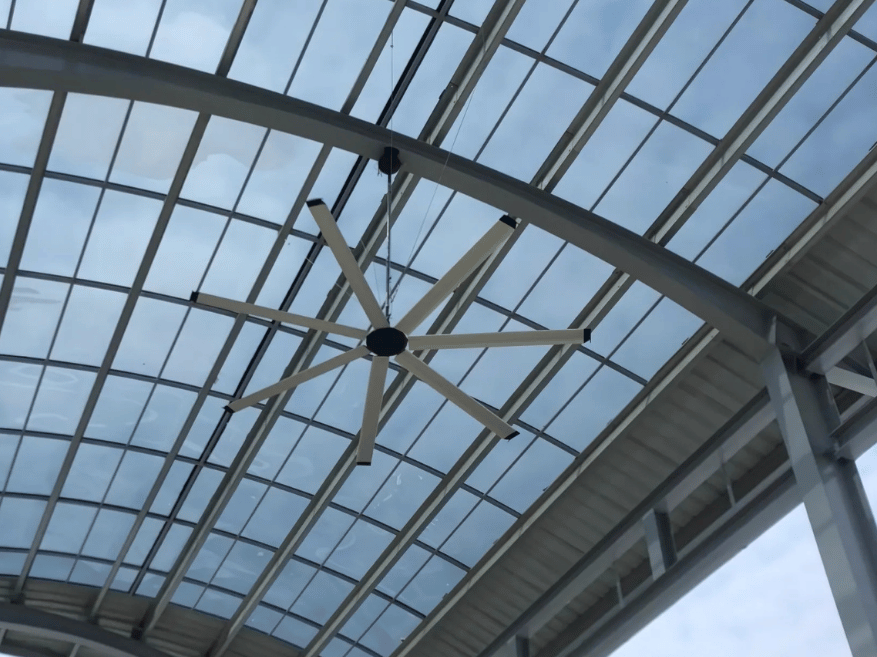
–5°C
Floor temperature reduction
Average destratification benefit via HVLS in 8–12m ceiling facilities — measured post-installation, no refrigeration involved
"Every June, July, August our output numbers fall. We've always blamed staffing. But we hire more summer temps and it still happens."
— The hidden cost of heat stress that never appears as a line item but shows up every quarter in the numbers
It isn't the staffing. It's the heat. And the staffing problem is caused by the heat. These variables are not independent of each other — they're the same problem at different points in the causal chain.
The physiology is well-documented: at ambient temperatures above 30°C without adequate air movement, the human body diverts blood flow to the skin to dissipate heat. This reduces cognitive function, reaction time, and physical stamina. For warehouse pickers walking 12–18km per shift or assembly workers performing repetitive precision tasks, the effect accumulates across the shift and produces measurable output decline.
Distribution centers and factories operating BigFans.vn Hamilton Air HVLS systems document 15–22% improvement in summer pick rates and production output compared to pre-installation baselines at the same facility. Error rates decline by similar margins. Heat-stress safety incidents drop 60–75%.
The financial arithmetic is often larger than the energy saving: for a facility processing 15,000 orders per day at a 15% summer productivity reduction, recovering that gap is worth more monthly than the total HVLS installation cost. Most operations managers who calculate this number correctly report that the HVLS paid back from productivity recovery alone — before counting a single dollar of energy saving.
Real Quote
"We were hiring 30 extra seasonal workers every summer just to compensate for the heat slowdown. After HVLS, we hired 8. The fans paid for themselves before the first summer was over."

"We spend more maintaining our cooling system than we realized. Compressor service, refrigerant, filters — it never stops."
— The ongoing maintenance burden that gets buried across multiple cost centers and never appears as one visible number
The maintenance burden of industrial cooling systems is consistently underestimated at the capital expenditure stage. What gets approved is the installation cost. What gets paid, year after year, are the service contracts, emergency callouts, refrigerant recharges, filter replacements, compressor rebuilds, and control system updates — none of which appear in the original CapEx justification.
Hamilton Air HERO-series HVLS fans use PMSM (permanent magnet synchronous motor) direct-drive technology with no gearbox, no drive belt, no brushes, and no refrigerant. The bearing system is sealed for life. There is no scheduled maintenance schedule — because there is nothing scheduled to maintain. Motor rated life: 50,000+ hours, which at 10 hours per day is approximately 14 years of operation before the first major component consideration.
The only recurring task: blade cleaning 1–2 times per year to remove accumulated dust. Total time per unit: 20–30 minutes. Total parts cost: zero. This is not a low-maintenance system — it is, in practical terms, a zero-maintenance system for the majority of its operating life.
Maintenance Comparison — 2,000m² Facility
HVLS annual maintenance cost | ~$0
|
HVLS scheduled overhaul | None required
|
HVLS motor life rated | 50,000+ hours
|
AC maintenance + refrigerant/yr | $8,000–$18,000
|
AC major overhaul (every 5–8 yr) | $15,000–$40,000
|
10-yr maintenance saving (HVLS) | $100,000–$180,000
|
"We run the AC at full blast but every time a truck arrives and the dock door opens, the floor heats back up. We're essentially cooling outside."
— The fundamental incompatibility between active loading dock operations and AC cooling that no setpoint adjustment can fix
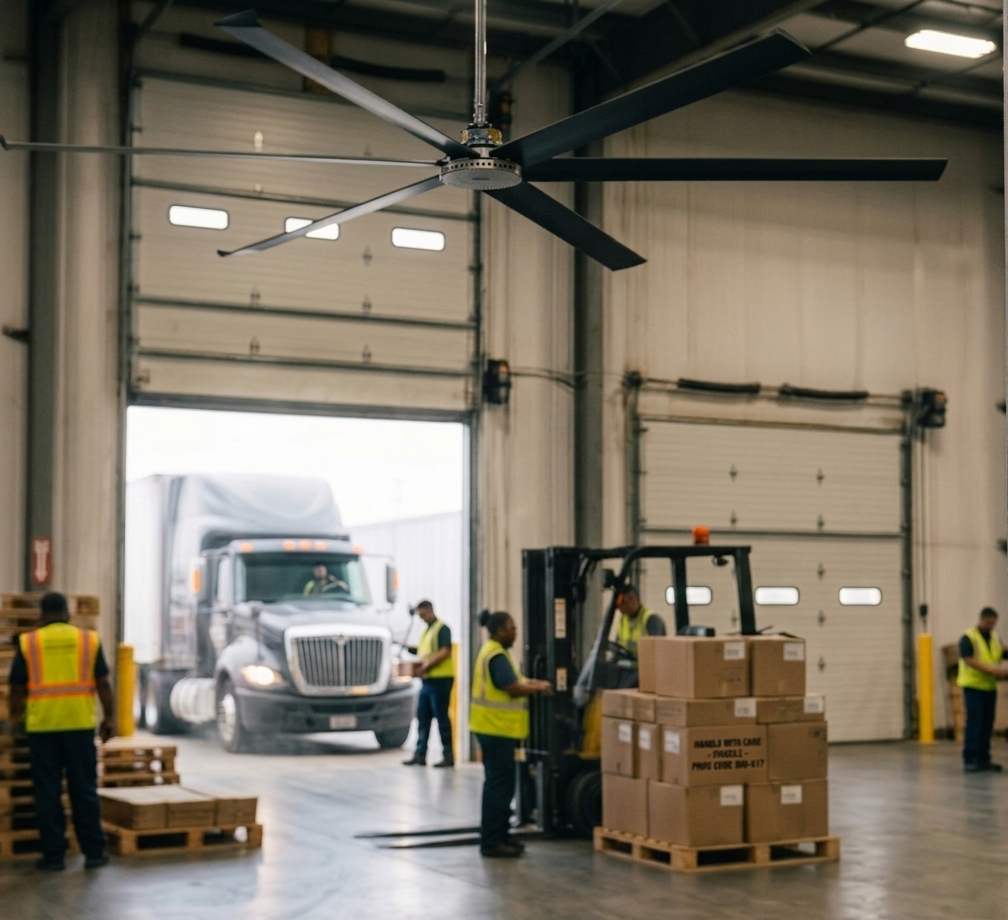
AC cooling depends on one thing above all else: a sealed thermal envelope. Open a 4m × 4.5m loading dock door for a 10-minute truck docking cycle and 40–65% of the conditioned air in that bay zone exchanges with outside air. The AC detects the temperature rise and runs at maximum capacity to recover setpoint. By the time it's close to recovering, the next truck is at the dock.
In a distribution center processing 80–120 truck movements per day across 6–8 docks, AC never reaches steady-state efficiency. It operates in continuous recovery mode, drawing peak power almost constantly while delivering 25–35% of its rated comfort output. The energy meter tells the full story: you're paying for AC capacity that logistics operations structurally prevent from working.
HVLS fans have no thermal envelope to maintain. They create airflow-based evaporative cooling directly on the skin of workers on the floor — a mechanism that functions identically whether the dock door is open or sealed. The truck traffic that destroys AC performance has zero measurable effect on HVLS cooling effectiveness.
All 5 Benefits at a Glance
The problem, the HVLS resolution, and the documented outcome — in one place.
Your Problem | HVLS Benefit | Documented Outcome | |
01 | Cooling energy bill too high | Energy cost slashed | –94% vs. AC · $23K saved/yr at 2,000m² |
02 | Floor hotter than thermostat shows | Thermal stratification eliminated | –4 to –6°C floor temp without refrigeration |
03 | Summer output consistently lower | Productivity recovered | +15–22% summer output · –72% heat incidents |
04 | Endless maintenance costs | Near-zero maintenance | ~$0/yr · 50,000+ hr motor life |
05 | AC useless when dock doors open | Door-independent cooling | 100% effectiveness regardless of dock activity |
The Most Common Questions About HVLS Benefits
The top 8 benefits: (1) 40–60% cooling energy cost reduction; (2) thermal stratification elimination — floor temperature drops 4–6°C without refrigeration; (3) 15–22% summer productivity improvement; (4) near-zero maintenance with 50,000+ hour motor life; (5) elimination of AC-related production stoppages; (6) loading dock-independent cooling performance; (7) real-time ESG energy documentation for buyer compliance; (8) 30–40 dB noise reduction to conversation-level operation.
One Hamilton Air HERO-5 V300i (7.3m) covers 2,000–2,500m² at 3 kW. Equivalent industrial AC draws 80–120 kW — a 27:1 energy ratio. Annual operating cost: $900/year (HVLS) versus $24,000–$36,000/year (AC including maintenance). The installation pays back in 12–18 months at Vietnamese electricity tariffs, then generates $23,000+ annual saving permanently for 15+ years.
Yes — with documented evidence. BigFans.vn Hamilton Air installations 2022–2025 document 15–22% improvement in summer pick rates and production output versus pre-installation baselines. Error rates decline by similar margins. Heat stress incidents drop 60–75%. Voluntary summer turnover falls 25–35%. The mechanism: uniform 0.5–1.0 m/s floor-level airflow accelerates evaporative skin cooling, allowing workers to maintain peak performance across the full shift rather than experiencing progressive heat-related decline.
Thermal stratification is the natural layering of air by temperature in tall spaces. In a 10m ceiling facility, ceiling-level air can be 8–15°C warmer than floor-level air. AC systems cool at duct height, not floor level — so workers experience temperatures much higher than the thermostat reads. HVLS fans mix ceiling and floor air continuously, eliminating this gradient. Result: floor temperature drops 4–6°C without refrigeration. In AC-equipped facilities, this allows the setpoint to rise 3–5°C with the same floor comfort — reducing AC energy by 20–35%.
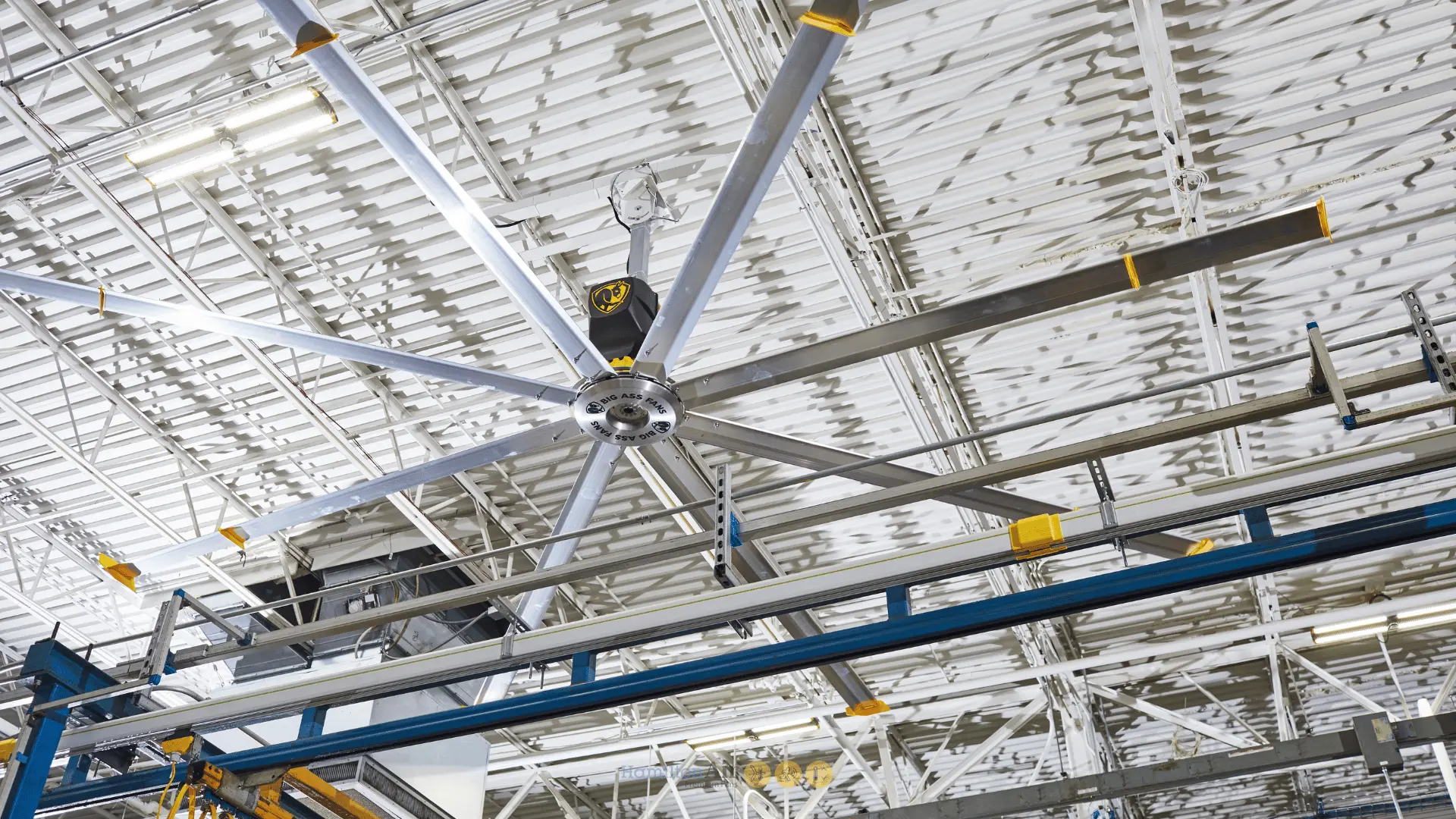
Figuring out your airflow needs can be complex—especially on your own. Get in touch and let our airflow experts guide the way.
Contact Office & Showroom
📍 Address: 304-306 Truong Van Bang Street, Cat Lai, Ho Chi Minh City
📧 Email: bigfans@hamiltonair.vn
📞 Hotline (24/7 Support): +84 909 899 367
📞 Residential Ceiling Fan Consultation: +84 915 123 860
📞 HVLS Large Fan Consultation: +84 913 123 860


