
01 — Why Coverage Shrinks
Four Things That Create Dead Zones
The spec sheet covers the best-case scenario. Real industrial spaces are never best-case. These are the four factors that consistently reduce effective coverage.
Tall Racking & Shelving
Racking above 4m deflects and absorbs horizontal airflow spread. Each aisle perpendicular to the spread direction reduces far-side coverage by 20–35%. Most common cause of dead zones in logistics warehouses.
Mezzanine Levels
A mezzanine blocks the air column from reaching the floor below it — and creates a separate micro-environment above it. Areas under mezzanines require supplemental fans specifically for that zone.
Dock Doors & Loading Bays
Open dock doors create pressure differentials that pull conditioned air out and draw hot outside air in. This disrupts the floor-level airflow pattern in a 15–20m radius around each open door.
Off-Centre Placement
A fan mounted 8m off-centre in a 40m-wide building produces asymmetric coverage — overshooting one side, undershooting the other. Placement precision matters as much as fan count.
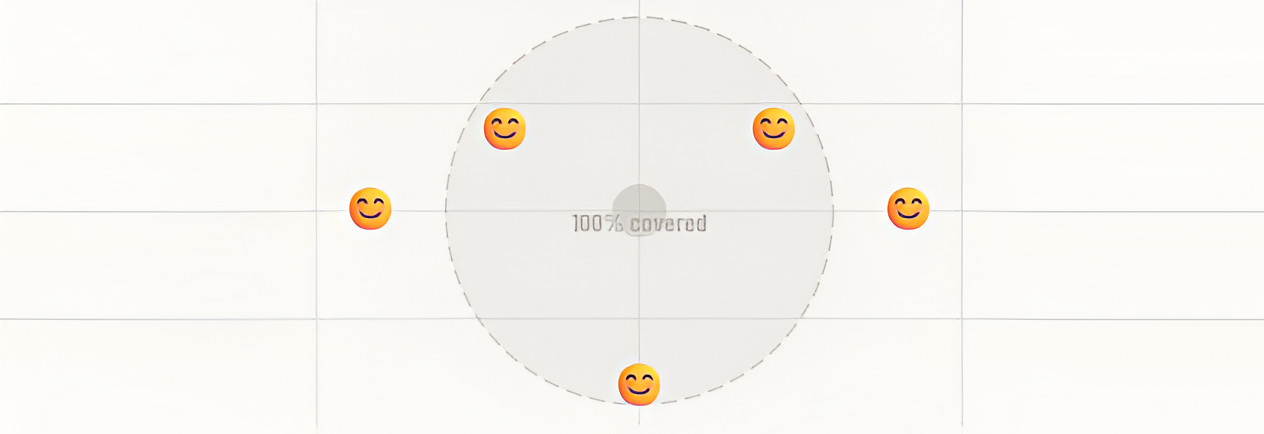
★ Real Warehouse — Typical Conditions
Racking, columns, dock doors, off-centre mount
~900m²

Spec Sheet — Ideal Conditions
Empty room, 10m ceiling, centred fan, no obstructions
2,500m²
02 — Placement Strategy
Three Layout Patterns — Only One Works
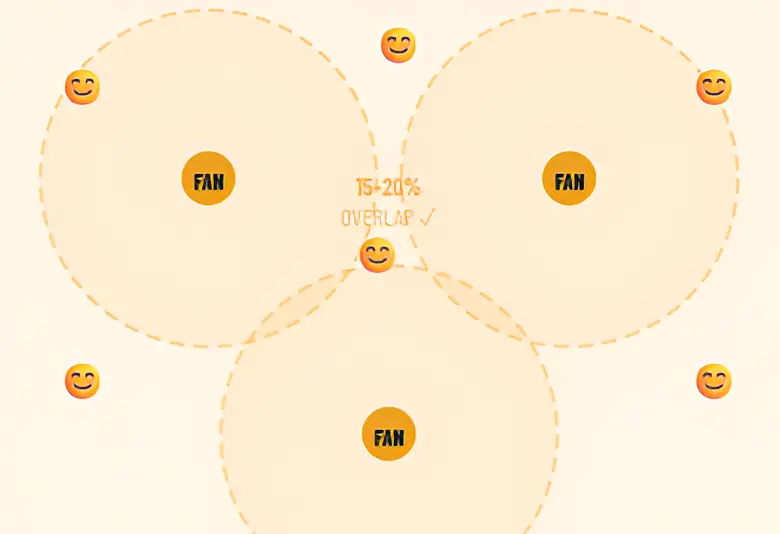
Same building. Same three fans. Completely different results depending on where they go. Placement determines performance more than product specification.
38% covered

Fans overlap in centre. Corners and edges receive zero airflow. Workers at perimeter experience dead zone conditions despite having 3 fans installed.
61% covered

Better edge coverage but fans placed too close to walls — half the coverage circle goes outside the building. Centre zone between fans is undersupplied.
94% covered
Fans overlap in centre. Corners and edges receive zero airflow. Workers at perimeter experience dead zone conditions despite having 3 fans installed.
03 — Obstructions
How to Handle the Real-World Layout
Every industrial facility has obstructions. The solution is not to ignore them — it's to plan around them specifically.
📦
Pallet Racking — Rows Perpendicular to Spread
Each full-height rack row perpendicular to the spread direction cuts the far-side effective coverage by 20–35%. The air hits the rack face and can't travel through.
→ Fix: align fan spread direction with rack aisles, not across them. Add supplemental fan on far side if needed.
🏗️
Mezzanine Floors
Area under a mezzanine is physically cut off from the main fan coverage above. Treat it as a separate zone requiring its own dedicated fan — typically a smaller V200i at the mezzanine ceiling height.
→ Fix: install dedicated HERO-5 V200i at the underside of the mezzanine ceiling, independently.
🚪
Open Loading Dock Doors
Open dock doors create 15–20m pressure disruption zones. HVLS fans near open docks should be positioned to create an air curtain effect — pulling floor air inward — rather than pushing it out.
→ Fix: position fan coverage centre 12–15m from dock door face, not directly above it.
🏭
Process Equipment & Large Machinery
Large presses, tanks, CNC centres, and assembly rigs above 3m height create coverage shadows. Workers on the lee side of equipment from the fan receive reduced airspeed.
→ Fix: position fans so spread direction runs parallel to equipment alignment, not into its face. Add directional fan at operator stations on the far side.
Hamilton Air HVLS Range
Industrial Ceiling Fans HERO Series
The Hamilton Air HVLS range — PMSM gearless motors, aerodynamic aluminium blades, IP55 to IP68 protection. Coverage from 600 m² to 2,000 m² per fan.
HERO-5 V300i
Standard workhorse — ideal for light manufacturing facilities, showrooms, supermarkets and sports halls. PMSM gearless motor, VFD control, minimum ceiling height 3.5m.
View Details →HERO-5 V200i
Compact variant — optimised for mid-size warehouses, workshops and schools. Minimum ceiling height 3.0m, lightweight construction, straightforward installation.
View Details →HERO-6 V380e
Next-generation model — 3-phase 380V PMSM motor, IP65 dust-tight and water-jet protected. Optional IoT connectivity, app control. Designed for logistics warehouses and manufacturing plants.
View Details →HERO-6 ADF
Advanced Distributed Flow (ADF) technology delivers uniform airflow across the entire footprint, eliminating hot spots. Optimised for shopping centres and mixed-use industrial spaces.
View Details →HERO-6 X Series
IP65 / IP68 rated — unique in the Vietnam market. Operates under direct wash-down conditions: food processing plants, aquaculture facilities, seafood processing and coastal environments.
View Details →HERO-8 ADF
Flagship — 8-blade ADF up to 7.3m diameter. Maximum airflow for mega logistics warehouses, airports, exhibition centres and large-scale sports venues.
View Details →


