
01 — Why It Matters
Same Diameter. Same Motor.
3× Different Floor-Level Airspeed.
Two 7.3m fans with the same motor can produce 0.2 m/s and 0.7 m/s floor-level airspeed respectively. The difference is entirely in the blade design.
✈️
01
Airfoil Profile
A curved airfoil creates lift and stronger airflow. The NACA cambered profile delivers 15–30% more airflow per watt than flat blades.
📐
02
Pitch Angle
The blade angle affects airflow. 11–15° is the optimal range for maximum CFM and smooth, low-noise operation.
🔢
03
Blade Count
5–8 blades balance airflow and efficiency. 6 blades are the industry standard, while 8 blades suit large open spaces.
⚗️
04
Material
6061-T6 aluminum alloy offers high strength, low weight, and precise manufacturing for durable, balanced HVLS fan blades.
02 — Airfoil Physics
The Airfoil Profile —
Where Performance Is Won or Lost
The cross-sectional shape of the blade determines how efficiently it converts rotation into downward air movement. This is the most important — and least visible — design decision in an HVLS fan.
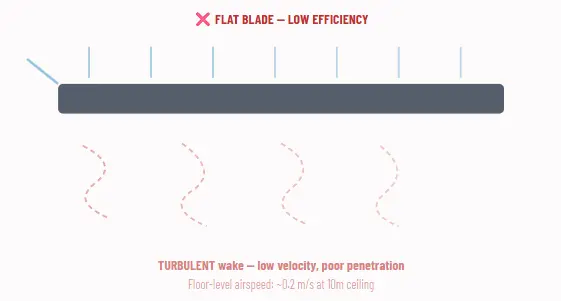
❌ FLAT BLADE – WHAT GOES WRONG
Air splits at the flat edge, creating turbulence and wasting about 40% of airflow. The airflow quickly loses speed before reaching the floor, resulting in poor coverage and higher noise.
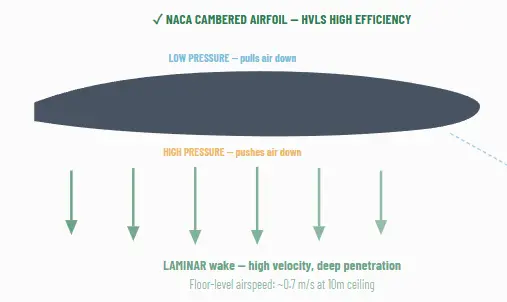
✅ CAMBERED AIRFOIL – WHAT HAPPENS CORRECTLY
The curved airfoil creates a pressure difference that keeps airflow attached to the blade. This produces a smooth, high-velocity air column with better floor coverage and lower noise.
03 — Pitch Angle
Pitch Angle — The Setting That Separates Performance from Stall
Pitch angle (angle of attack) determines the operating point on the fan's performance curve. Too low: insufficient airflow. Optimal: maximum laminar efficiency. Too high: blade stalls and turbulence replaces laminar flow.
8–11°
Sub-optimal
Airflow
Moderate
Efficiency
Acceptable
Noise
Low-mid
Result
Usable
Airflow
Moderate
Efficiency
Acceptable
Noise
Low-mid
Result
Usable
11–15
★ Optimal
Airflow
Maximum
Efficiency
Peak
Noise
45–55 dB
Result
Best
Airflow
Maximum
Efficiency
Peak
Noise
45–55 dB
Result
Best
15–18°
Over-pitched
Airflow
Moderate
Efficiency
Declining
Noise
Increasing
Result
Marginal
Airflow
Moderate
Efficiency
Declining
Noise
Increasing
Result
Marginal
04 — Blade Count
5 to 8 Blades — What Each Configuration Delivers
More blades is not always better. The optimal count depends on the balance between coverage uniformity, motor load, and specific application requirements.
5
Blades
Motorload
Lowest
Coverage
Good
Uniformity
Moderate
Noise
Very low
Best for
Mid-size areas
Motorload
Lowest
Coverage
Good
Uniformity
Moderate
Noise
Very low
Best for
Mid-size areas
8
Blades
Motorload
Highest
Coverage
Maximum
Uniformity
Maximum
Noise
45–55dB
Best for
Mega warehouses
Motorload
Highest
Coverage
Maximum
Uniformity
Maximum
Noise
45–55dB
Best for
Mega warehouses
7
Blades
Motorload
Higher
Coverage
Excellent
Uniformity
Very high
Noise
45–55dB
Best for
Large open areas
Motorload
Higher
Coverage
Excellent
Uniformity
Very high
Noise
45–55dB
Best for
Large open areas
6
★ Optimal
Motorload
Balance
Coverage
Excellent
Uniformity
High
Noise
45–55dB
Best for
Most industrial
Motorload
Balance
Coverage
Excellent
Uniformity
High
Noise
45–55dB
Best for
Most industrial
Our most selected products at Hamilton Air
Each model selected on four criteria: design, performance, durability and suitability for Vietnam's climate.
Minimalist Scandinavian wood blade fan — the #1 architect's choice for villas and premium apartments.
Energy-saving integrated LED ceiling fan — the optimal 2-in-1 solution for living rooms, restaurants and cafés.
Aerodynamic aluminium blades for premium commercial spaces, showrooms and hotel lobbies.
Large HVLS ceiling fan for commercial spaces. Strong airflow and quiet operation, ideal for resorts and garden restaurants.
Premium heritage-style wood blades — an interior statement piece for villa living rooms and European-style restaurants.
The most premium large-blade commercial fan — wide coverage, luxury design, BMS-ready with smart control.
Bắt đầu viết ở đây...


