
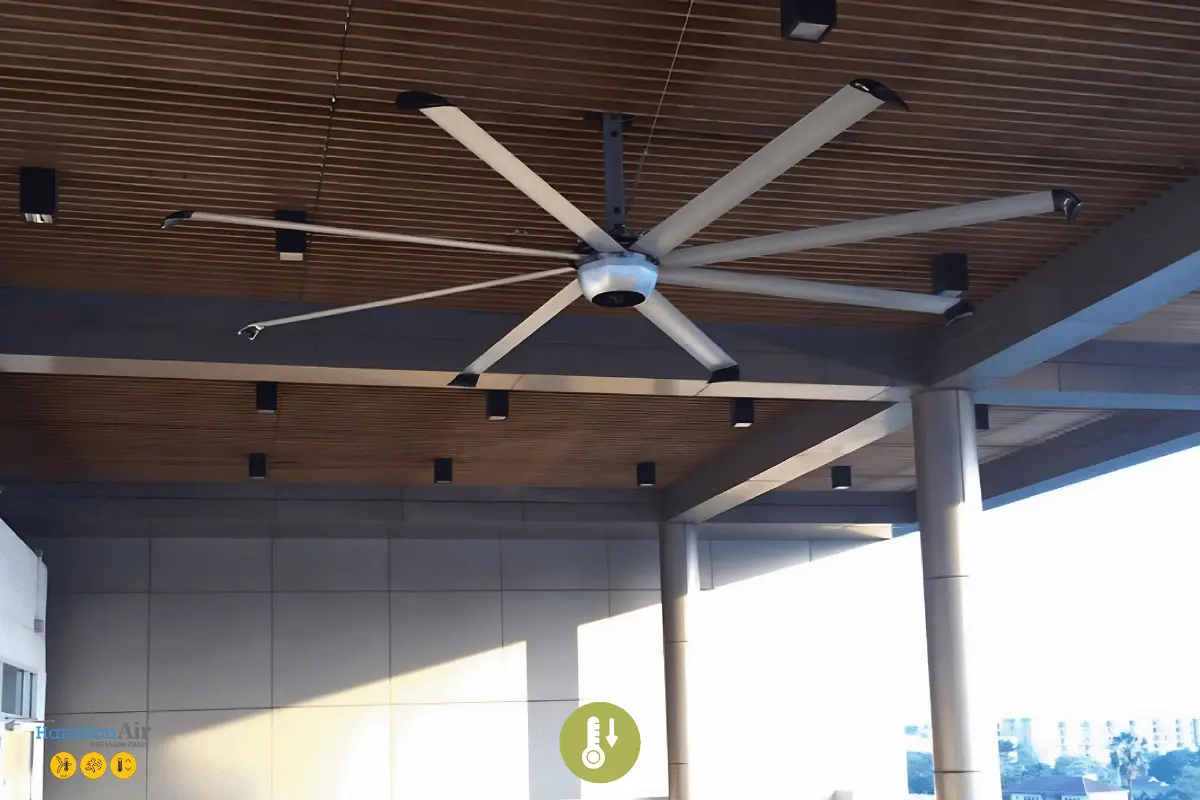
BigFans.vn Full Product Range
| HVLS Industrial (Hamilton Air) | 6 models |
| Industrial Fans (Coolibri + Sunon) | 5 models |
| Large Ceiling Fans | 4 models |
| IP ratings available | IP55 → IP68 |
| Coverage range per fan | 350 → 2,500 m² |
| Applications covered | Factory → Showroom |
| Free service | Site survey + layout |
01 — The Definition
What Does HVLS Actually Mean?
Four letters that describe a completely different approach to moving air in large spaces — and once you understand the name, everything about the technology makes immediate sense.
H V L S
High Volume Low Speed
High Volume: Each fan moves an enormous quantity of air — up to 316,000 CFM (cubic feet per minute) from a single unit. That's equivalent to replacing the entire air volume of a 2,000m² warehouse every few minutes.
Low Speed: The blades rotate at only 30–75 RPM — slow enough that you can count the rotations. This low speed is not a limitation; it's the mechanism. Large blades moving slowly displace far more air than small blades spinning fast, and they distribute it uniformly across the entire floor instead of concentrating it in a narrow stream.
HVLS Fan
Large blade · Slow spin
Massive uniform volume
Diameter: 3.0–7.3m · RPM: 30–75 · Coverage: 2,000–2,500m² · Noise: 45–55 dB
Traditional Industrial Fan
Small blade · Fast spin
Narrow high-velocity stream
Diameter: 0.5–1.2m · RPM: 800–1,400 · Coverage: 80–150m² · Noise: 75–95 dB
1998
Invented for dairy barns — first HVLS patent filed
2005
Adopted by US logistics giants — Amazon, FedEx DCs
2015
ESG & energy mandates accelerate global adoption
2020
Vietnam manufacturing sector begins large-scale HVLS adoption
2026
Now standard spec for new industrial builds in Southeast Asia
02 — The Mechanics
How HVLS Fans Work — Three Mechanisms
HVLS fans don't just move air around. They create cooling through three distinct physical mechanisms — each one working simultaneously to transform the thermal environment of the space.
1
Large Air Column
Floor Spread
The rotating blades push a massive column of air downward from ceiling level. When this column reaches the floor, it fans outward in all directions — like water from a tap — covering a 50m diameter floor zone from a single 7.3m fan. This is the Coandă effect: the low-velocity, high-volume air hugs the floor surface as it spreads, maintaining its velocity far beyond the blade tips.
3
Evaporative
Skin Cooling
The 0.5–1.0 m/s floor-level airspeed created by HVLS fans accelerates sweat evaporation on the skin. Evaporation removes heat from the body, measurably reducing skin surface temperature by 3–6°C. The perceived cooling effect is 5–8°C — physiologically real, not just psychological. This is the same mechanism that makes a breezy 30°C day feel more comfortable than still 28°C air.
2
Thermal
Destratification
In high-bay spaces, hot air naturally accumulates at ceiling level — often 15–20°C warmer than floor level. HVLS fans continuously mix this warm ceiling air with cooler floor air, collapsing the temperature gradient. Floor temperature drops 4–6°C without any refrigeration — purely from redistributing the thermal energy already present in the space. This is why the AC thermostat reads 26°C while workers feel 34°C: the thermostat is in the cooler mid-air layer, not the warm floor zone.
03 — Product Categories
Three Categories of Industrial & Commercial Fans — What's the Difference?
BigFans.vn offers three categories of fans covering every application from heavy industrial to commercial showroom. Understanding which category fits your space is the first step to selecting the right model.
Supplementary / Zonal
Industrial Fans
Coolibri (Italy) & Sunon (Taiwan)
| Models available | Pulsar II (Colibri) |
| Models available | Powersky X6 (Aeropower) |
| Models available | Series 10 (SUNON) |
| Operating principle | High-RPM axial |
| Best for | Spot cooling · Supplemental zones |
Commercial & Aesthetic
Large Ceiling Fans
| Models | Pandora V150e, V180e |
| Models | NOVA Series |
| Models | SUNON Powerful Series 1 |
| Diameter | 1.2 – 1.8 m |
| Noise | < 38–40 dB |
| Best for | Showroom · Office · F&B · Retail |
★ Core Product Line
HVLS Industrial Fans
| Blade diameter | 3.0 – 7.3 m |
| Floor coverage | 350 – 2,500 m²/fan |
| Operating speed | 30 – 75 RPM |
| IP rating range | IP55 → IP68 |
| Motor type | PMSM Direct Drive |
| Best for | Factory · Warehouse · DC · Hangar |
Who Needs HVLS Fans? Match Your Facility to the Right Category
Every application below is a real situation where HVLS has delivered documented results. Find yours — and note the specific model family recommended for each.
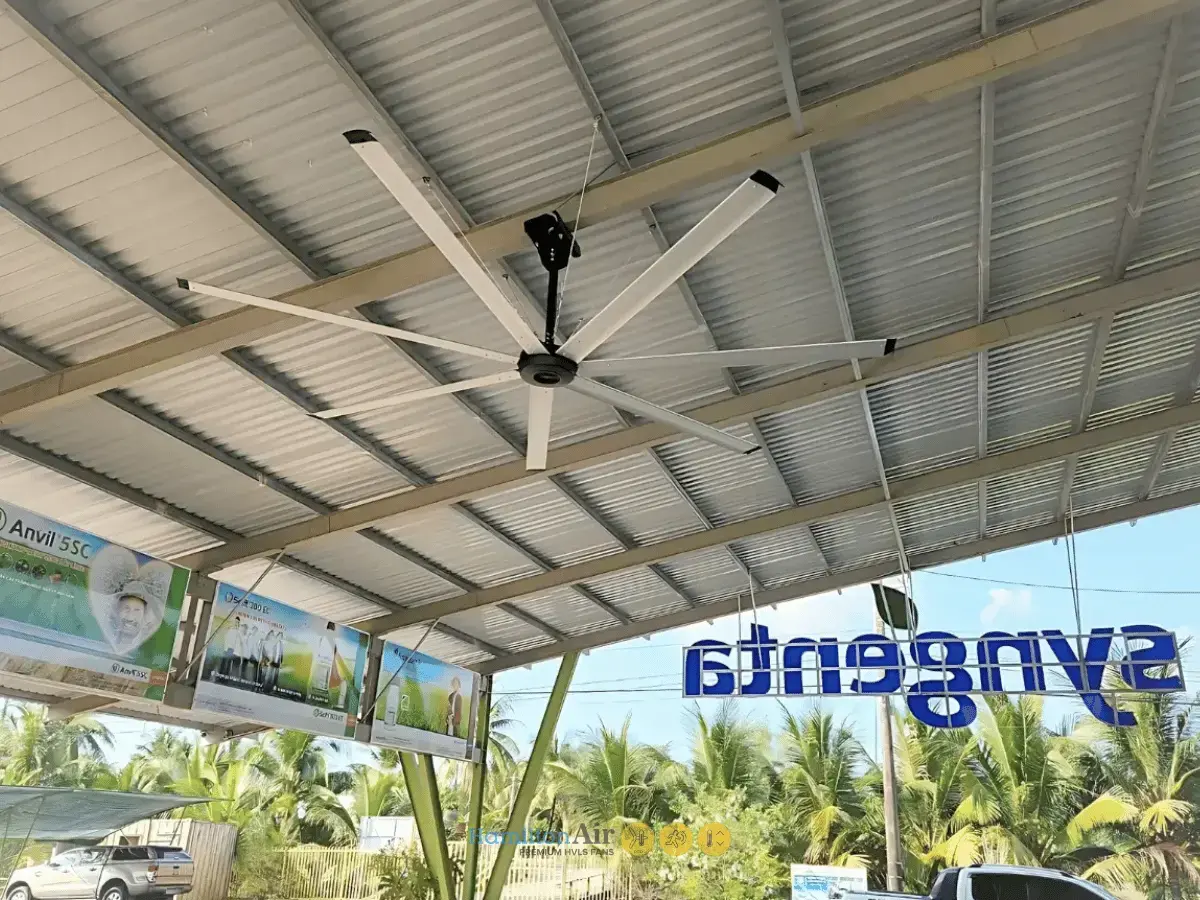
Manufacturing & Assembly Plants
Open-plan factory floor, 6–12m ceiling, mixed machinery heat load. Workers mobile across the floor. Summer output consistently 15–20% lower. AC either not installed or ineffective with open doors.
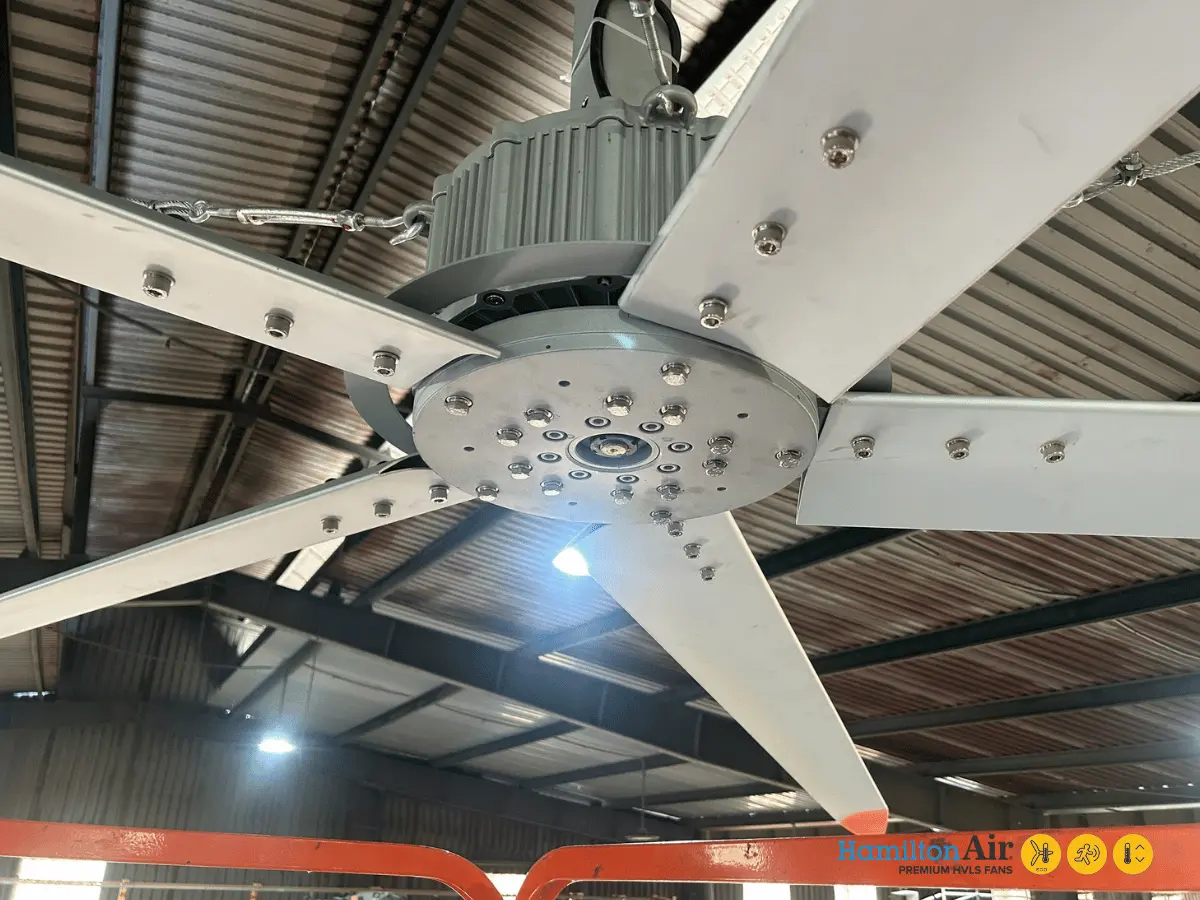
Warehouses & Distribution Centers
High-bay racking, frequent loading dock activity, 24/7 operations. Freight handlers experiencing heat stress. ESG buyer audits requiring documented energy reduction data.
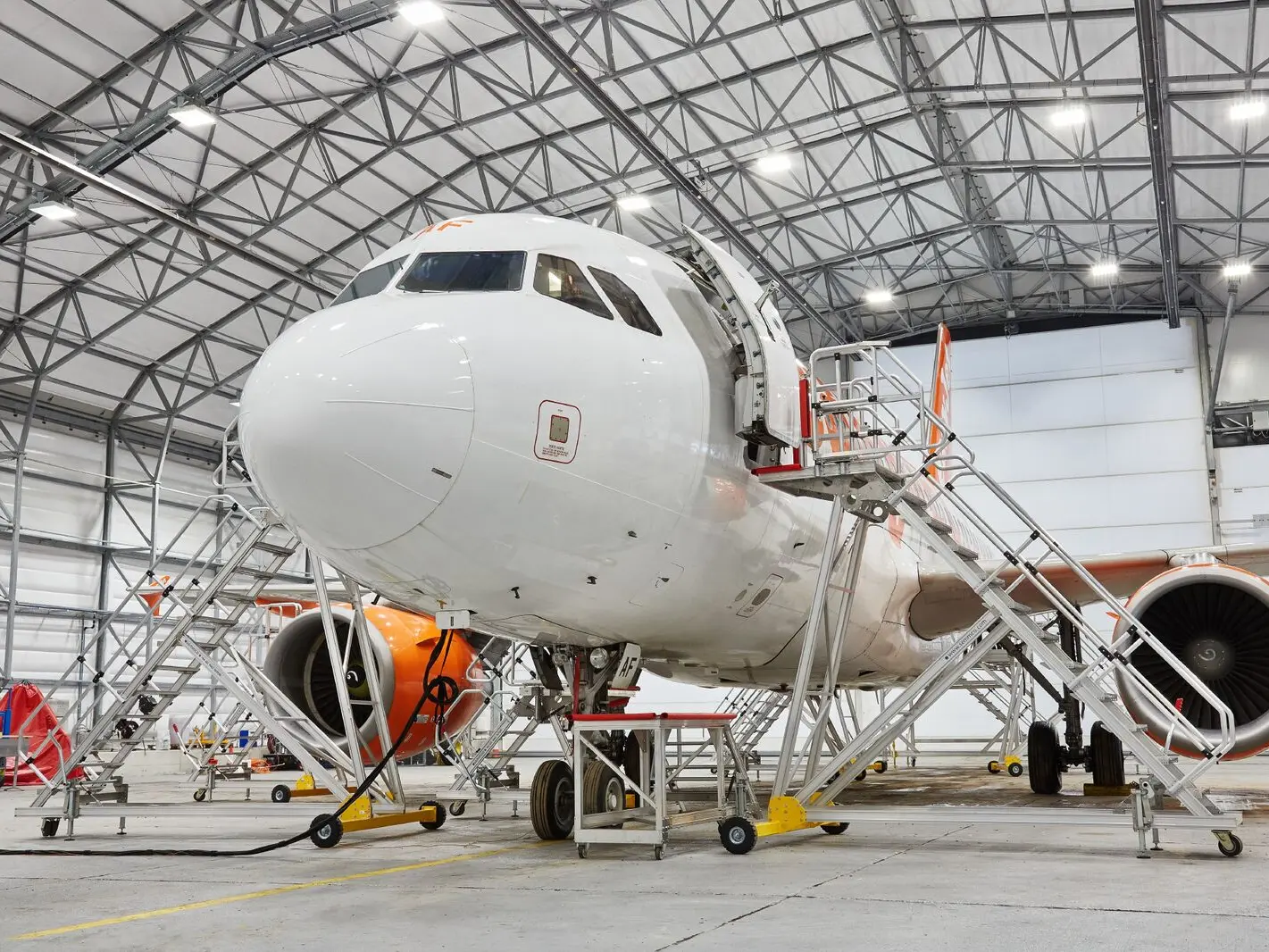
Aircraft Hangars & Large Span Spaces
Very large open floor areas (5,000–20,000m²+), high clearance ceilings. Single-zone cooling strategy required. Structural mounting must handle the dynamic load of large-diameter fans.
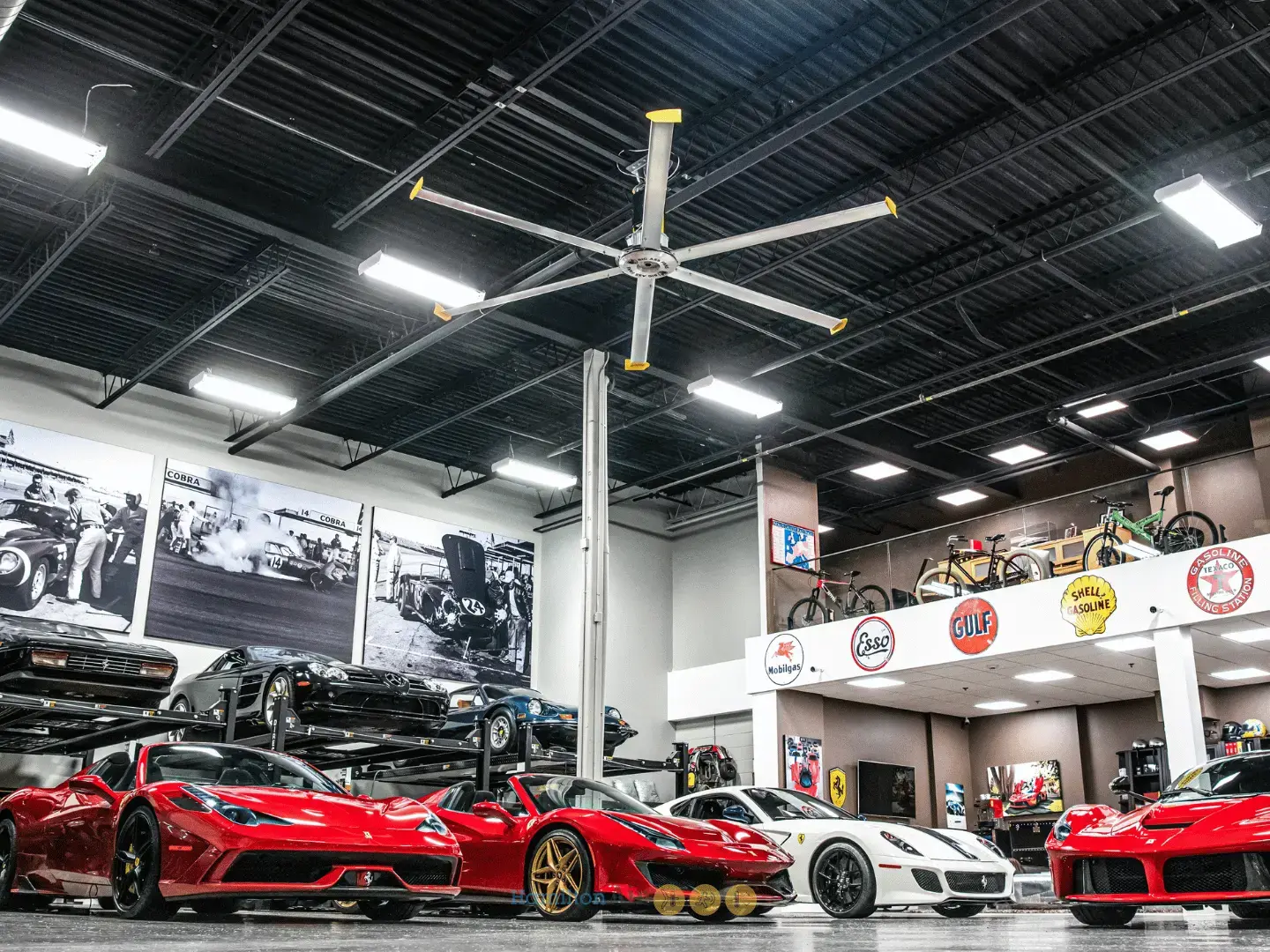
Showrooms, Offices & Commercial Spaces
Retail showrooms, car dealerships, furniture stores, F&B spaces, coworking offices. Cooling performance required but aesthetic integration is equally important. Silent operation critical.
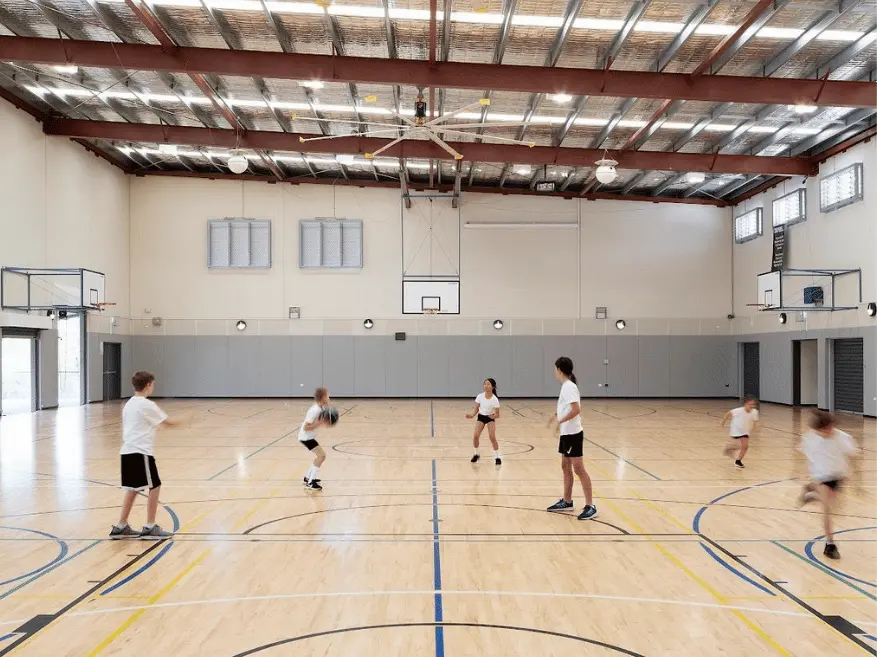
Sports Halls, Gyms & Recreation Facilities
Large enclosed volume, high occupancy during events, variable heat load. Ceiling mounting is standard. Noise level critical — must not disrupt events or training.
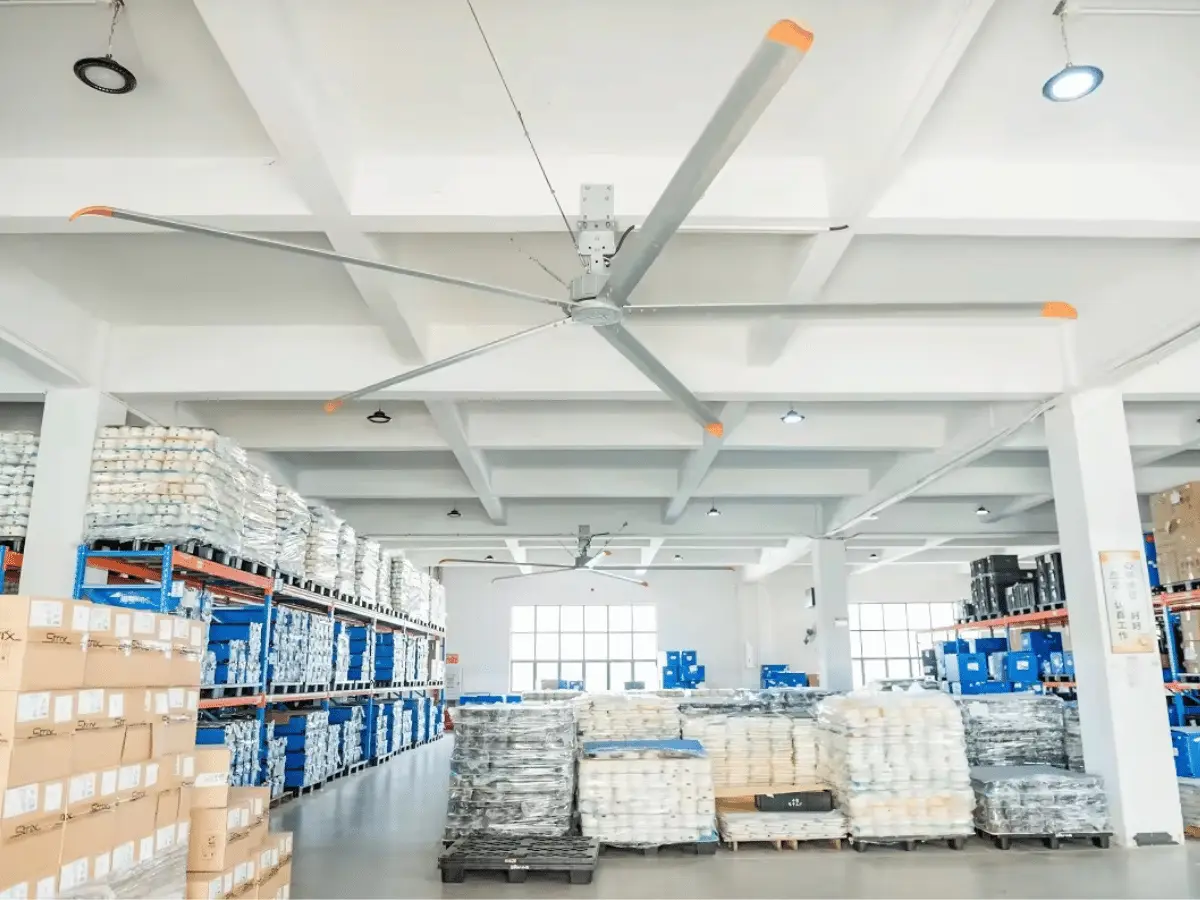
Food Processing & Cold Chain
Regular washdown cycles, high humidity, HACCP compliance requirements. Fans must withstand chemical cleaning agents and water ingress. IP68 is not optional — it is mandatory.
05 — The Core Question
HVLS Fans vs Air Conditioning — Do You Need One or Both?
The most common question from first-time buyers. The honest answer is nuanced — and depends on your specific situation.
HVLS Only
For factories & warehouses not running AC now
HVLS provides 5–12°C perceived cooling through destratification and evaporative cooling. For most manufacturing and warehousing applications, this is sufficient to maintain worker productivity and safety — without a compressor in sight.
AC Only
Skin Cooling
AC without HVLS makes sense for: data centers, server rooms, pharmaceutical cleanrooms, and offices under 200m² where a sealed envelope is maintained and air movement above 0.3 m/s would create problems.
★ Best Combination
For factories & warehouses not running AC now
HVLS destratification allows AC setpoint to rise 3–5°C while maintaining floor comfort — reducing AC energy by 20–35%. HVLS handles the floor coverage AC cannot reach efficiently. The combination delivers better results than either alone, at lower combined operating cost.
Everything You've Wanted to Ask About HVLS Fans
HVLS stands for High Volume Low Speed. High Volume: each fan moves up to 316,000 CFM of air — enough to replace the entire air volume of a 2,000m² warehouse every few minutes. Low Speed: blades rotate at only 30–75 RPM — slow enough to watch the blades turn. The low speed is deliberate: large blades moving slowly create a massive, uniform air column rather than a narrow, noisy high-velocity stream.
HVLS fans work through three simultaneous mechanisms: (1) Large air column floor spread — slowly rotating large blades push massive air volume downward, spreading across up to 50m floor diameter when it reaches ground level. (2) Thermal destratification — the vertical air circulation mixes warm ceiling air with cooler floor air, reducing floor temperature 4–6°C in high-bay spaces. (3) Evaporative skin cooling — 0.5–1.0 m/s floor-level airspeed accelerates sweat evaporation, producing 5–8°C perceived temperature reduction. Combined effect: 5–12°C total perceived cooling with no refrigeration.
Traditional fans spin small blades (0.5–1.2m) very fast to push a narrow, high-velocity air stream at a specific target. HVLS fans spin large blades (3–7.3m) slowly to move massive air volume uniformly across an entire floor. One 7.3m HVLS fan covers 2,000–2,500m² at 3 kW. Achieving equivalent coverage with traditional fans requires 18–22 units consuming 36–44 kW — a 12:1 energy ratio. HVLS also creates thermal destratification that traditional fans physically cannot deliver regardless of quantity.
Two variables determine your answer: ceiling height (determines fan diameter) and floor area (determines fan count). For ceilings 6–12m: HERO-5 V300i (Ø 5.5–7.3m) is standard. For 4–6m ceilings: HERO-5 V200i (Ø 3.1–5.0m). For commercial spaces (showrooms, offices): Pandora V150e/V180e or NOVA Series. Fan count: divide floor area by coverage per fan × 1.15 for 15% overlap, round up. Use the Product Selector on this page for a model match based on your specific situation, or request a free site assessment for exact specifications.
Two variables determine your answer: ceiling height (determines fan diameter) and floor area (determines fan count). For ceilings 6–12m: HERO-5 V300i (Ø 5.5–7.3m) is standard. For 4–6m ceilings: HERO-5 V200i (Ø 3.1–5.0m). For commercial spaces (showrooms, offices): Pandora V150e/V180e or NOVA Series. Fan count: divide floor area by coverage per fan × 1.15 for 15% overlap, round up. Use the Product Selector on this page for a model match based on your specific situation, or request a free site assessment for exact specifications.
Bắt đầu viết ở đây...


