Compare
Same perceived comfort — very different cost
26°C
Air temp (AC)
Still air, 0 m/s
32°C
Air temp (HVLS)
Moving air, 1.0 m/s
Same perceived comfort · 10× less energy
80kW
AC power draw
per 2,000m²
3kW
HVLS power draw
per 2,000m²
=
=
The Science
How Your Body Actually Cools Itself
Not through air temperature. Through evaporation. Moving air is the catalyst — without it, the cooling system stalls.
1. Core temp rises → sweat activates
Heat or physical activity triggers sweat glands. Water reaches the skin surface as a cooling film — ready to evaporate and carry thermal energy with it.
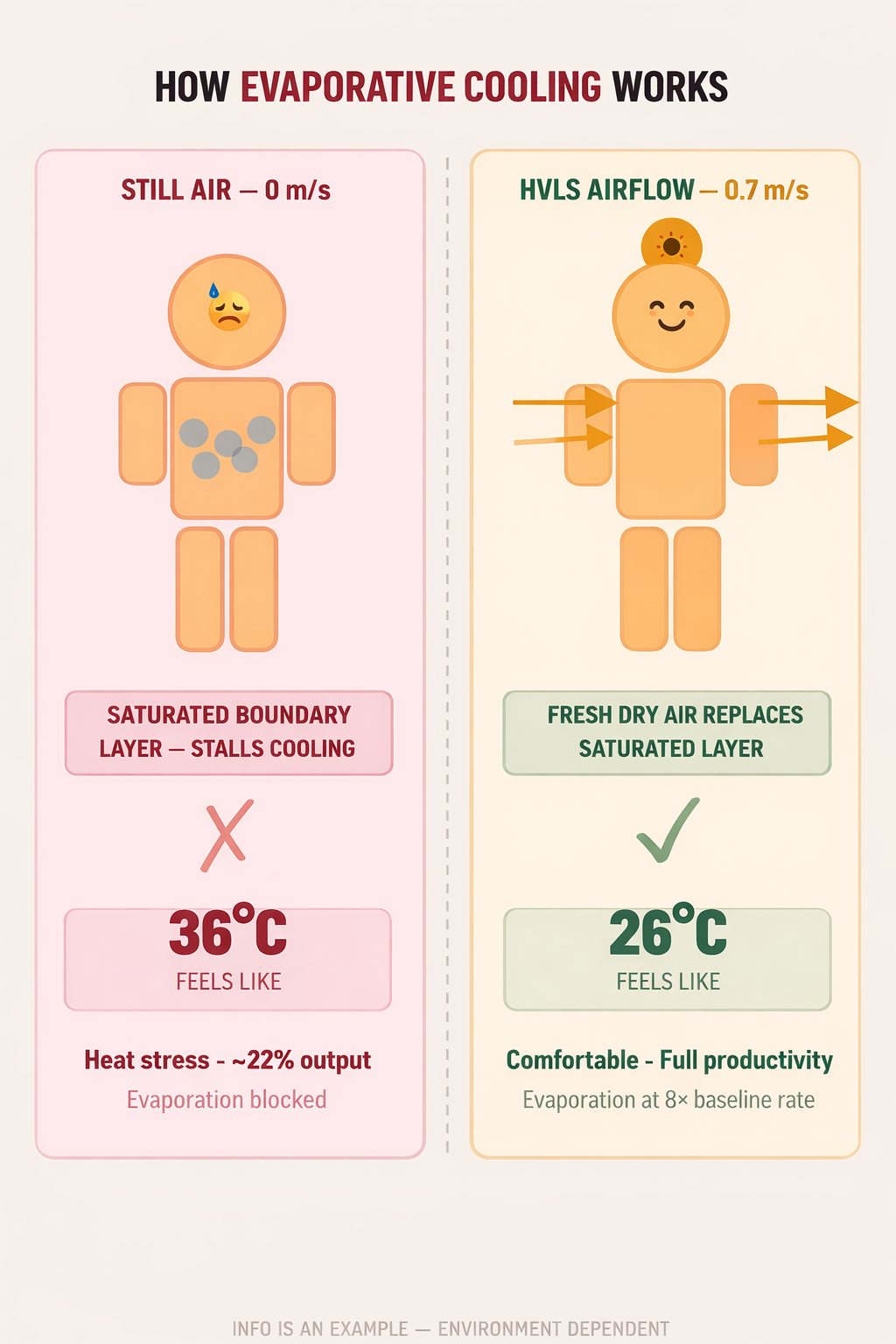
2. Still air: boundary layer saturates
In still air, the thin layer touching your skin becomes humid within seconds. Evaporation slows to near-zero. The cooling system stalls. Heat stays in the body.
3. Moving air: saturated layer replaced
In still air, the thin layer touching your skin becomes humid within seconds. Evaporation slows to near-zero. The cooling system stalls. Heat stays in the body.
4. Skin cools → body feels 5–8°C cooler
Accelerated evaporation physically lowers skin temperature by 3–6°C. The brain registers this as a cooler environment. The air hasn't changed temperature. You have.
Evaporation Rate
More Airspeed = More Cooling — Up to a Point
Evaporation rate scales with airspeed — but there's a sweet spot where cooling is maximum and disruption is zero.
At 34°C ambient + 0.7 m/s HVLS airflow
26°C
Perceived temperature
8°C cooler than actual
Evaporation Rate
Same Worker. Three Outcomes.
Temperature and airspeed interact. This is what the combination actually looks like on the factory floor.
❌ Scenario A — No cooling
34°C
0 m/s · Still air
No evaporation. Heat builds in the body through the shift. Worker fatigues early, error rates climb, breaks increase.
$0
Energy cost/yr
But ~$180K in lost productivity
★ Scenario B — HVLS airflow
34°C
0 m/s · Still air
Same temperature. Evaporation at 8× rate. Feels like 26°C. Full productivity maintained through the complete shift.
$2,700
Annual energy cost
3 fans · 5,000m² · full coverage
💸 Scenario C — AC only
26°C
0 m/s · Still air
Same comfort as Scenario B. But dock doors open — warm air floods in. AC runs 100% to recover. Real efficiency: 30%.
$72K+
Annual energy cost
300–500 kW draw · 5,000m²
Hamilton Air HVLS Range
Industrial Ceiling Fans HERO Series
The Hamilton Air HVLS range — PMSM gearless motors, aerodynamic aluminium blades, IP55 to IP68 protection. Coverage from 600 m² to 2,000 m² per fan.
HERO-5 V300i
Standard workhorse — ideal for light manufacturing facilities, showrooms, supermarkets and sports halls. PMSM gearless motor, VFD control, minimum ceiling height 3.5m.
View Details →HERO-5 V200i
Compact variant — optimised for mid-size warehouses, workshops and schools. Minimum ceiling height 3.0m, lightweight construction, straightforward installation.
View Details →HERO-6 V380e
Next-generation model — 3-phase 380V PMSM motor, IP65 dust-tight and water-jet protected. Optional IoT connectivity, app control. Designed for logistics warehouses and manufacturing plants.
View Details →HERO-6 ADF
Advanced Distributed Flow (ADF) technology delivers uniform airflow across the entire footprint, eliminating hot spots. Optimised for shopping centres and mixed-use industrial spaces.
View Details →HERO-6 X Series
IP65 / IP68 rated — unique in the Vietnam market. Operates under direct wash-down conditions: food processing plants, aquaculture facilities, seafood processing and coastal environments.
View Details →HERO-8 ADF
Flagship — 8-blade ADF up to 7.3m diameter. Maximum airflow for mega logistics warehouses, airports, exhibition centres and large-scale sports venues.
View Details →


