
Head-to-Head: Same Space, Same Goal
55
RPM — HVLS
Diameter
7.3m
Coverage
2,500m²
Units needed
1 fan
Power draw
3 kW
Noise
48 dB
1,400
RPM — Traditional
Diameter
0.9m
Coverage
100m²
Units needed
fan
Power draw
44 kW
Noise
85 dB
VS
The Physics
Airflow Volume = Blade Area × RPM
Speed is only half the equation. Blade area — which scales with diameter squared — is the dominant variable.

CFM = π·r² × RPM × K
Blade area scales with diameter squared. Double the diameter → 4× the blade area → 4× the airflow at the same RPM. A 7.3m HVLS blade sweeps 66× more area per rotation than a 0.9m industrial fan blade.
The Pattern Difference
How the Air Actually Moves
Volume is only part of the story. How air is distributed across the floor matters just as much — and here the gap widens further.
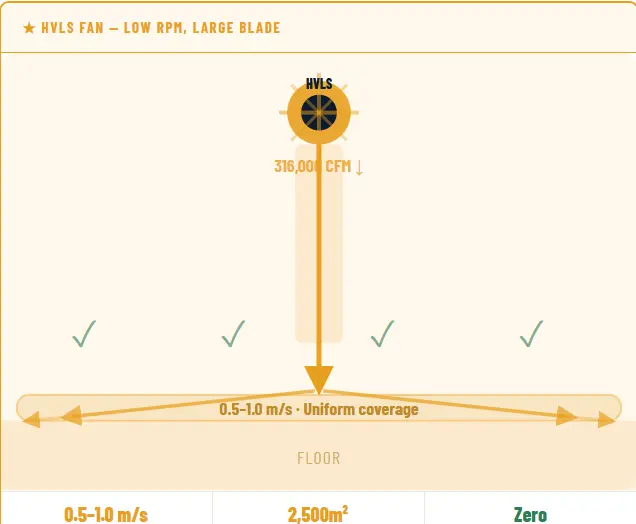
0.5–1.0 m/s
Floor velocity
2,500m²
Coverage area
Zero
Dead zone
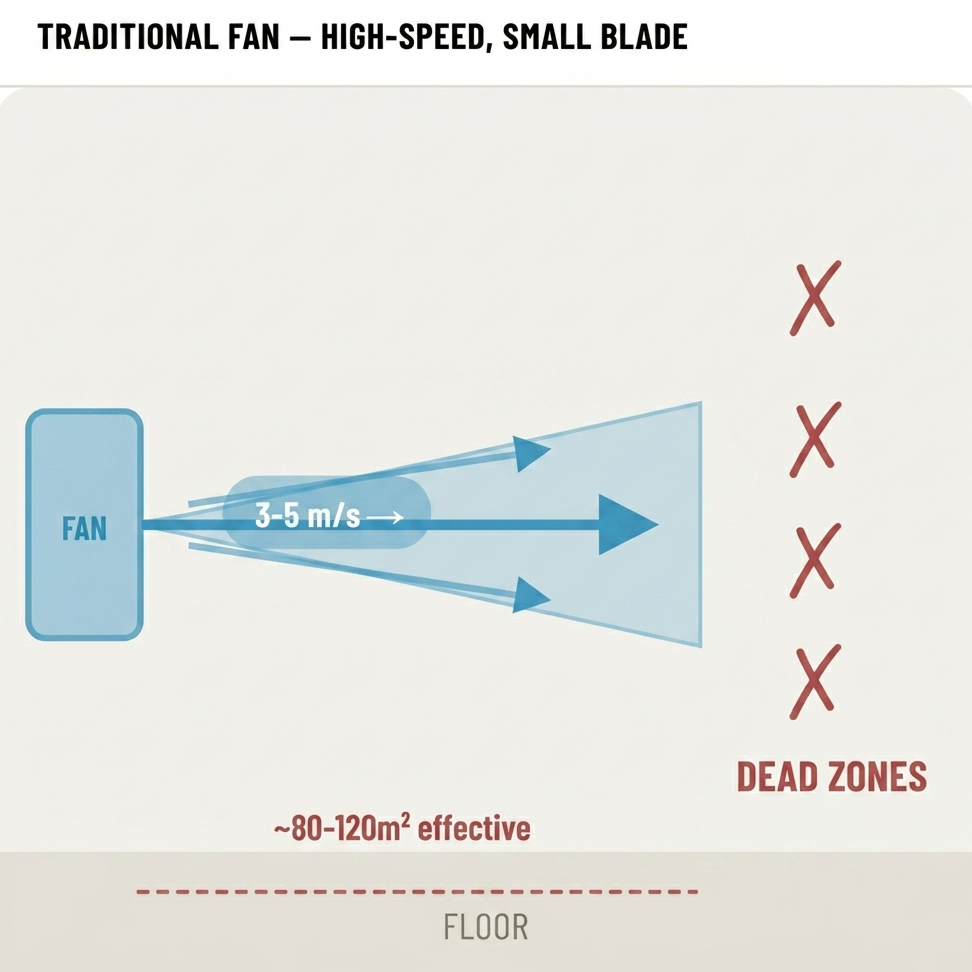
3–5 m/s
Peak velocity
~100m²
Coverage area
Many
Dead zones
The safe velocity insight: Traditional fans at 3–5 m/s blow papers off desks and disrupt assembly work. HVLS at 0.5–1.0 m/s is above the effective evaporative cooling threshold (0.3 m/s) but below the disruption threshold for industrial workplaces. More coverage, safer velocity, no dead zones.
The Numbers in Context
RPM Comparison — Full Scale
From ceiling fans to jet turbines — where HVLS sits, and why that position is optimal for industrial airflow.
⚡Too Fast
High RPM creates turbulence, noise, and energy waste. Air velocity above 1.5 m/s disrupts workplaces. Structural vibration risk in large blades.
✓ Optimal — 30–75 RPM
Produces 0.5–1.0 m/s floor velocity — above evaporative cooling threshold, below disruption threshold. Maximum volume, minimum noise.
💤 Too Slow
Below 0.3 m/s floor velocity, evaporative cooling effect disappears. Air movement falls below the threshold the human body registers as cooling.
The Product
Hamilton Air HVLS Range
Industrial Ceiling Fans HERO Series
The Hamilton Air HVLS range — PMSM gearless motors, aerodynamic aluminium blades, IP55 to IP68 protection. Coverage from 600 m² to 2,000 m² per fan.
HERO-5 V300i
Standard workhorse — ideal for light manufacturing facilities, showrooms, supermarkets and sports halls. PMSM gearless motor, VFD control, minimum ceiling height 3.5m.
View Details →HERO-5 V200i
Compact variant — optimised for mid-size warehouses, workshops and schools. Minimum ceiling height 3.0m, lightweight construction, straightforward installation.
View Details →HERO-6 V380e
Next-generation model — 3-phase 380V PMSM motor, IP65 dust-tight and water-jet protected. Optional IoT connectivity, app control. Designed for logistics warehouses and manufacturing plants.
View Details →HERO-6 ADF
Advanced Distributed Flow (ADF) technology delivers uniform airflow across the entire footprint, eliminating hot spots. Optimised for shopping centres and mixed-use industrial spaces.
View Details →HERO-6 X Series
IP65 / IP68 rated — unique in the Vietnam market. Operates under direct wash-down conditions: food processing plants, aquaculture facilities, seafood processing and coastal environments.
View Details →HERO-8 ADF
Flagship — 8-blade ADF up to 7.3m diameter. Maximum airflow for mega logistics warehouses, airports, exhibition centres and large-scale sports venues.
View Details →Quick Answers
Because the blades are very large. At 7.3m diameter, the blade tips are already moving at significant linear velocity even at 55 RPM. Spinning faster would create turbulence, noise, and energy waste — all without proportionally more useful airflow. The slow rotation is the mechanism, not a limitation. It's optimal for the blade size.
Yes — because the coverage area is not the blade circle but the floor spread. The downward air column created by the fan reaches the floor and fans outward horizontally (Coandă effect), covering a ~50m diameter floor zone at ceiling heights of 6–12m. The blade sweeps 42m². The floor coverage is 2,500m². That ratio is the key to HVLS performance.
Yes — and it's precisely calibrated. Below 0.3 m/s, the human body doesn't register meaningful evaporative cooling from airflow. Above 1.5 m/s in most workplaces, papers fly and concentrated airflow becomes uncomfortable. HVLS at 0.5–1.0 m/s sits in the optimal band: effective for evaporative skin cooling, safe for assembly and office work, and consistent across the entire 2,500m² coverage zone.


